A few flaws hold it back, but the latest Settlers game is the series' most charming to date.
The little workers that follow your orders in The Settlers 7 are a tireless lot. They mine for coal, shear sheep, chop wood, and smelt iron yet ask for so little in return. In fact, if you don't have anything for them to do, they might cry out for a little work to ease the burden of their own laziness. And when you play this economy-heavy strategy game, you'll be just as busy--and content--as these tiny computer people. The latest in the long-running Settlers franchise is as charming and enjoyable as past installments, though it's hard to escape on-again, off-again online troubles that have plagued the game since release. Even if you are only interested in The Settlers 7 for its single-player features, you have to be connected to the Internet and signed into Ubisoft's online portal to play. Unfortunately, server problems occasionally make the game inaccessible for hours at a time, which is an issue that does not appear to be improving as the weeks pass. 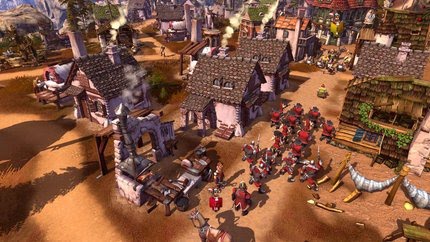
If you're the patient type, however, you'll probably want to put up with the ongoing connectivity issues simply because The Settlers 7 is fun to play. It isn't as complex or as varied as similar offerings--Dawn of Discovery, for example, or even previous Settlers games--but it has a mesmerizing flow that has a way of pulling you in. The game is all about setting up supply lines by building appropriate structures and abodes in the appropriate places, and then balancing the stream of resources that your settlers then automatically collect. Then you expand your realm across the map by taking over connected settlements, whether they be neutral or already taken by an opponent. The campaign starts you off slow, introducing you to concepts one by one, but in time, you discover just how complex the economic web can be. For instance, you need wood to make planks, which are in turn used as a basic building material for standard structures. Your armies require fancy food, which means you need to build lodges near forests teeming with wildlife or build piggery extensions onto your farms. Then, you need to make sure to attach a butcher annex onto a noble house--which itself requires regular food to operate.
This sounds complicated, but it's easy to get the hang of, and the game does a good job of pointing out gaps in your economic chain. If your mints aren't pumping enough gold into your coffers because you are low on the coal they need, a little icon will appear over the building in need to let you know. Matches can be challenging nonetheless, and resource imbalances may require you to approach things a little differently every time. For instance, you might need to gather wood on barren land. In that case, you need to add a forester annex to a lodge, and because main structures can only have three additions attached to them, space restrictions can become a concern. If you find there aren't many gold mines to empty, you can make beer to sell at your tavern, though then you are redirecting a resource used to attract clerics to your realm. You're constantly forced to make adjustments throughout the course of a single match, and failing to pay attention can have disastrous consequences.
There are times when you'll wish the game made it easier to keep track of things. In a typical match, you'll start expanding your kingdom quickly, and space restrictions might require you to place important structures in settlements other than your primary one. In time, it can become a burden to keep track of a stronghold (for creating troops), a church (for producing men of the cloth), and an export office (for hiring traders). Hotkeys or icons that let you quickly jump to these crucial buildings, along with your all-important tavern, would have been incredibly helpful. As it is, you need to remember where you placed such structures, and when you scroll to that settlement, you must be able to visually identify the structure in question so you can click on it. Other interface improvements would also have been welcome (being able to click on the icons in the build queue to jump directly to that structure, for example), but some flaws aside, it's easy to get around the map by scrolling or clicking on various nodes on the skeletal minimap. If you scroll all the way out, you'll switch to a helpful bird's-eye view that shows you where resources are located, the status of the opposition's expansion, and other helpful tidbits. 
Armies provide the most straightforward way of expanding, and you'll easily crush the neutral armies that protect most unconquered settlements. There's nothing complex about combat; you just click on an army, click on a sector to attack, and off they go. Battles are an automated affair that comes down to sending enough of the right types of troops. Once you've gotten your economy going, you might have multiple armies moving about, each led by a different general, but military might doesn't mean easy triumph. You can win by vanquishing your enemies' primary hubs, but most of the time, you'll overcome your foes by earning a set number of victory points. You might earn a victory point by having more gold than your adversaries, earning more prestige (accumulated by placing prestige structures like statues), or capturing specially designated villages, for example. This system provides flexibility and a bit of unpredictability, and the resulting tug of war is tense and enjoyable.
You'll want to start with the campaign, which helps you get up to speed on all the economic intricacies. The straightforward story is buoyed by Princess Zoe--and her excruciating French accent--who must yank the land of Tandria from the clutches of some flamboyantly histrionic enemies. Missions begin with lovely pop-up storybook updates, occasionally punctuated by impressive and colorful cutscenes. These highlights help make up for the not-so-subtle plot development you'll see coming from the beginning, though the campaign is really just an extended tutorial for the more substantial multiplayer and skirmish modes. In skirmishes, the AI provides a decent challenge and does a good job of adapting, and while there aren't a whole lot of maps, you can edit them in various ways (change victory conditions, for instance), which keeps things somewhat fresh. If you want even more adaptive competition, you can head online, where both ladder (ranked) and unranked matches await. Online play is smooth and matches are of a goodly length (often over an hour), but you might have trouble finding games online.
Vibrant colors and a somewhat goofball art design make The Settlers 7's lush forests and ghost-ridden swamps leap right off the screen, and the animations make the game as fun to watch as it is to play. The exaggerated movements of your miners as they hop into a mining car are delightful; even constructors exude endless charm as they bound toward their destination. There is a distracting blur effect used on more distant objects, though it seems more noticeable at certain resolutions and can be hard to get used to. The wonderful soundtrack provides a nice complement to the sun-drenched visuals, featuring light orchestral fare, a bit of harp strumming, and even some Celtic-inspired vocal warbles. 
Some of The Settlers 7's more interesting features are the peripheral ones. You can customize your castle with different ornaments, windows, flags and such. An integrated achievements system lets you post your accomplishments to your Facebook profile if you so wish, while you can call on another player for assistance with the click of a button. The flipside of this social friendliness, of course, is the inherent unfriendliness of an unstable online-only copy-protection scheme. That drawback and others aside, The Settlers 7 offers something for everyone, whether you're an experienced armchair economist or just like watching little virtual people run up and down the roadways carrying pails of water.
Exploding a building is fun. Exploding a building on top of your friend's speeding car: priceless.
Things explode in Split/Second. Bridges blow up and collapse, huge tankers slip from their moorings and slide into the nearby sea, and helicopters blow apart into a million shards of metal and glass. And while all of this mayhem happens in a fictionalized reality television setting in the game's single player experience, you can harness this mayhem to your advantage in Split/Second's eight-player multiplayer action. After all, sending a jumbo jet crashing to earth is fun enough by yourself; crashing it into your friends and ruining their race? Well, that's just priceless.
At a press event in San Francisco this evening, Disney showed off two multiplayer events in the game: survival mode and standard races. Both are quite similar to their single-player counterparts but the addition of real drivers to the events seems to raise the stakes a bit. In survival mode, your goal is to end the race with the most points--you earn those points by passing eighteen-wheeler trucks. Pass multiple trucks in a row without crashing and you'll earn a combo modifier. The complication here are the color-coded exploding barrels that are falling off the trucks as they wildly slide around the track; blue barrels will knock you off course and running into a red barrel will destroy your car completely. Survival mode matches last three minutes with a thirty-second sudden death period tacked on to the end of a race--which gives you a last desperate sprint to earn additional points. However, if you die in a sudden death, your car will not respawn.
Survival mode is a nice change of pace but, apart from the copious exploding barrels, there's not a lot of the mayhem you've come to expect from the game in this mode--there's no exploding scenery and no power plays… you know, the stuff you want from Split/Second. The real action for Split/Second's multiplayer is with the races themselves. Here, so many factors matter: the class of car you choose (the speedy sports cars, the strong and stable trucks, or the balanced muscle cars), the path you choose through the game's ever-evolving levels and, of course, when you use the all-important power plays.
You earn power plays by pulling off fancy moves on the track--drifting, drafting, jumping, and so on. If you have enough power play juice you can execute an on-track event by pressing the A or X buttons (on the Xbox 360 controller). A typical power play moment usually involves something blowing up on one side of the road or the other--and it's usually enough to knock an opponent car sideways, slowing them down, but not necessarily stopping them completely. A massive power play, executed with the B button once the meter is filled, can completely change the outcome of a race. These are the events in Split/Second that you paid your hard-earned money to sea--huge oil tankers crashing down on top of you, driving through the middle of smoky tunnels while industrial equipment swings through the air, promising to take you out at the slightest mistake, airport control towers shattering and crumbling to the ground.
In addition to unleashing periodic chaos, power plays can also occasionally open up new paths for you to take. When and red or blue arrow pops up on screen, you can initiate a power-play to take a previously unavailable shortcut that can save you a few seconds or more on your lap time. Timing shortcuts is important in races--it's very satisfying to open up a shortcut at the last possible moment and essentially screw your opponent of the opportunity.

In between multiplayer races, you'll be able to compare yourself with your opponents in a number of ways. You earn credits depending on the position your finished in the previous race; think of them as simply championship points for your online session. There's also a racing number, which is essentially an overall ranking that gauges your skill--the better you drive, the lower your number will be (with #1 being the best rank of all). Split/Second developers told us that you can improve your ranking even if you aren't winning races. Finally, any achievements you earn in the game will show up as decals on the car you're driving in a race; you won't be able to place those decals yourself (they're automatically added to your car) but anyone driving against you will be able to see exactly what you've accomplished in the game.
Based on our hands-on time with the game, Split/Second appears to be good fun online. The frame rate held up fairly well, even with all of the on-screen chaos happening all around. Of course, it remains to be seen how that performance will match up to the real world settings once the game is released but we're keeping our fingers crossed that it will hold up. Disney promises more information on single-player and multiplayer modes in Split/Second before the game's May 18 release, so look for more soon.
Source: Gamespot.com
Shatter Review
Shatter is brick breaking at its best--simple, innovative, and beautiful.
The simple concept of brick breaking as the basis for a video game is almost as old as video games themselves. Breakout first came to home consoles more than 30 years ago, captivating countless players with nothing but a paddle, a bouncing ball, and a ton of bricks. Shatter breathed new life into this old concept when it was released for the PlayStation 3 last year, and now it has come to the PC. Shatter's numerous innovations, coupled with gorgeous visuals and an exceptional soundtrack, make it feel not so much like a step forward for the brick-breaker genre as a bold reinvention of it. 
In Shatter, you control a small machine called a bat that has a convex surface and the ability to move along only one edge of the playing field. As you guide this plucky little mechanism in its quest to overthrow its oppressors, you'll encounter wave after wave of bricks impeding your progress, just crying out to be destroyed. Luckily, you have just the thing to get the job done. The bat can fire a ball capable of breaking the bricks that stand in your way, and your goal is to keep the ball in play as long as possible, sending it on a collision course with bricks that need breaking and not letting it get past you when those same bricks send it back your way. The allure of this well-worn action lies in its simplicity. There's an unfettered purity to the gameplay that can lure you into a state of profound focus, where all that matters is keeping the ball in play and increasing your score. When you're fully absorbed in the action, it's very exciting.
The additions Shatter makes to this tried-and-true formula are remarkable because they introduce compelling new elements to the gameplay without distracting from the simplicity at its core. The most significant of these is the ability to suck and blow air with the bat, making minor adjustments to the ball's trajectory and vacuuming fragments of shattered blocks that fill up a special attack meter. This gives you a level of control over the action that extends beyond the bat itself and keeps you involved at all times--not just when you need to get the bat into position for a rebound. And if you like to live dangerously, you can launch two or more balls to ratchet up the challenge and increase your score multiplier. It's a cool risk-versus-reward option that is at your disposal at any time, so long as you have more than one ball to spare. There are also a few power-ups that significantly change the action when you collect them. Unstoppaball turns the ball into a destructive juggernaut that has a momentum oncoming bricks can't interrupt, while manueveraball makes the ball much more susceptible to the influence of your blowing and sucking, which lets you precisely steer the ball toward your intended target.
Shatter's inventiveness also spreads to level design. With horizontal, vertical, and even round level layouts, the position of the bat and the way the ball ricochets about the area is constantly shifting, which prevents levels from feeling too similar. There's also a great variety of brick types, including bricks that take several hits, bricks that try to blow the ball away, bricks that blow up other bricks around them, bricks that creepily multiply, and bricks that drift about in the contained atmosphere of the level. These last bricks mentioned can be quite a threat. If one of these loose bricks collides with the bat, it'll be knocked out of play for a brief moment, which can, of course, be deadly if you fail to catch the ball as a result. Thankfully, you have a shield that can protect you from these bricks, but using it drains the meter for your special attack, which is called the shard storm. This attack rains a devastating shower of shards on the bricks or boss in your way, which can be quite useful in a pinch. 
Speaking of bosses, each of Shatter's 10 worlds culminates in a boss battle, and most of these showdowns are thrilling and memorable. Each boss has a weak spot that you must attack with the ball, but introducing the ball to that weak spot is invariably easier said than done. You battle a clocklike machine with rotating arms that threaten to knock the ball away; a few menacing contraptions that have weaknesses you must reveal by blowing aside their armor; and perhaps most enjoyably of all, a bigger, badder bat. These battles make for a dramatic and satisfying conclusion to each world, and further cement Shatter's position as much more than just another brick-breaking game. The Story mode is great fun while it lasts, but sadly that's only a few hours. The gameplay certainly stands up to repeat playthroughs, but the novelty wears off a bit once you've seen all there is to see.
The PC version of Shatter costs two bucks more than the PS3 version. For that extra cash, you get two new game modes. Endless mode has you struggling to score as many points as possible against constantly evolving and respawning brick patterns. Time Attack plays just like Endless mode, but it limits you to five minutes. These modes can be played solo or with a friend in local cooperative play. Co-op puts one player in front of the other but swaps your positions frequently enough so that both players spend plenty of time getting first crack at every ball that comes their way. Endless and Time Attack give you more leaderboards to climb, but they lack the sense of progress that keeps the story mode engaging from moment to moment. Shatter supports play with a controller, a mouse/keyboard, or just a keyboard, and all of these schemes provide the precision you need in this type of game.
Shatter is best played with the lights out and the music up. Visually, Shatter follows in the footsteps of other retro-inspired downloadable games, such as Geometry Wars 2, giving everything a neon glow that makes it pop off the screen. Destruction is a beautiful thing here, particularly when you trigger sequences of explosions that leave tons of glowing shards in their wake. Keeping your eye on the ball can be tough when all of this is going on in the background, but it's not a problem that you're likely to have often. Even more impressive than the visuals is the music. Each of the 10 worlds has its own gorgeous electronic composition. These diverse tracks are good enough to stand on their own outside the context of the game, and when paired with the visuals and action of Shatter, they enhance the trancelike experience tremendously. 
Shatter wears its retro inspiration proudly in its visuals, and in the simple bleeps and bloops that serve as the occasional sound effects, but you don't need to be a fan of the games that inspired it or old enough to remember when they were introduced to enjoy Shatter. It's that rare game that builds on existing concepts in such a way as to create something entirely new while holding onto what made those concepts so compelling in the first place. Priced at $9.99, Shatter's irresistible action and the fact that it constantly taunts you with the next highest score on a Steam friend's leaderboard will make it an experience you'll keep coming back to long after you've smashed the final boss into a million little pieces.
Source: Gamespot.com
Trinity Universe First Look
If you put Disgaea and Atelier together, then you'd have yet another quirky role-playing game by NIS America.
Trinity Universe is a collaborative effort by Nippon Ichi Software, Gust, and Idea Factory where characters from the Disgaea and Atelier series will make an appearance in 3D for the first time. There are two storylines to play through, both of which take place in the Netheruniverse where there's a serious problem with space debris. The easier storyline follows the young demon god king, Kanata who, instead of transforming into a demon god gem to protect the Netheruniverse as he should, decides to run away and enjoy a life where there's an endless supply of soba noodles. The second storyline is for more experienced players and follows the valkyrie Rizelea who's taken it upon herself to restore peace in the Netheruniverse by hunting down the demon god king.
The setup for both stories is the same. After going through the initial story sequence, you'll move to a menu with a view of the Netheruniverse that is surrounded by an assortment of junk. This space debris includes tamago nigiri pieces, refrigerators, and delicious-looking cake. Because this stuff is colliding with the Netheruniverse, you must enter each piece--which is essentially a dungeon--to locate the gravitation core and destroy it so that the dungeon will float off into outer space. Not only do you need to fend off monsters while tracking down the core, but you also need to get out of there before you drift off into space with the rest of the garbage. From the menu, you can also access story events that are available, as well as other dungeons. The inn is open to you for free to rest up, and there's a shop should you need to stock up on items. Certain things will be available depending on the time of day, so you can choose to spend the night at the inn or just take a quick nap.
As you explore the dungeons, battles for the most part are random, although there are some instances where a shadow will appear to hunt you down, and it may be tougher to beat, but it will also drop better items. Combat is turn based and based on the skill link system, where you press different face buttons for combos. By pressing the square, triangle, and X button in a specific order, you can execute chain attacks, which will cost fewer action points than if you were to attack randomly. The square button is used for lighter attacks, but you'll get more hits in, and the X button is for greater damage. The triangle and circle buttons are for spells and healing, respectively.
The build we had was still very early, so we didn't get a chance to check out all the features yet. We do know there's weapon customization that looks like it comes in the form of decals. With these graphics, you can decorate your weapons to enhance their stats. Depending on the graphic, it'll also affect the animation in battle. For example, with the cherry blossom design, you'll see a burst of flower petals as you fight. 
Familiar faces like Etna and Flonne will make an appearance, as well as the loveable but volatile penguinlike prinnies. You'll also learn more about the story as you watch the hilarious interactions between the wacky characters. They talk to each other via lightly animated character portraits, so you'll get that full anime/manga effect when you see different symbols appear as they start to get agitated or annoyed. Trinity Universe looks to follow the trend of keeping things lighthearted and fun, so be sure to look for the game when it is released in June.

