If you put Disgaea and Atelier together, then you'd have yet another quirky role-playing game by NIS America.
Trinity Universe is a collaborative effort by Nippon Ichi Software, Gust, and Idea Factory where characters from the Disgaea and Atelier series will make an appearance in 3D for the first time. There are two storylines to play through, both of which take place in the Netheruniverse where there's a serious problem with space debris. The easier storyline follows the young demon god king, Kanata who, instead of transforming into a demon god gem to protect the Netheruniverse as he should, decides to run away and enjoy a life where there's an endless supply of soba noodles. The second storyline is for more experienced players and follows the valkyrie Rizelea who's taken it upon herself to restore peace in the Netheruniverse by hunting down the demon god king.
The setup for both stories is the same. After going through the initial story sequence, you'll move to a menu with a view of the Netheruniverse that is surrounded by an assortment of junk. This space debris includes tamago nigiri pieces, refrigerators, and delicious-looking cake. Because this stuff is colliding with the Netheruniverse, you must enter each piece--which is essentially a dungeon--to locate the gravitation core and destroy it so that the dungeon will float off into outer space. Not only do you need to fend off monsters while tracking down the core, but you also need to get out of there before you drift off into space with the rest of the garbage. From the menu, you can also access story events that are available, as well as other dungeons. The inn is open to you for free to rest up, and there's a shop should you need to stock up on items. Certain things will be available depending on the time of day, so you can choose to spend the night at the inn or just take a quick nap.
As you explore the dungeons, battles for the most part are random, although there are some instances where a shadow will appear to hunt you down, and it may be tougher to beat, but it will also drop better items. Combat is turn based and based on the skill link system, where you press different face buttons for combos. By pressing the square, triangle, and X button in a specific order, you can execute chain attacks, which will cost fewer action points than if you were to attack randomly. The square button is used for lighter attacks, but you'll get more hits in, and the X button is for greater damage. The triangle and circle buttons are for spells and healing, respectively.
The build we had was still very early, so we didn't get a chance to check out all the features yet. We do know there's weapon customization that looks like it comes in the form of decals. With these graphics, you can decorate your weapons to enhance their stats. Depending on the graphic, it'll also affect the animation in battle. For example, with the cherry blossom design, you'll see a burst of flower petals as you fight. 
Familiar faces like Etna and Flonne will make an appearance, as well as the loveable but volatile penguinlike prinnies. You'll also learn more about the story as you watch the hilarious interactions between the wacky characters. They talk to each other via lightly animated character portraits, so you'll get that full anime/manga effect when you see different symbols appear as they start to get agitated or annoyed. Trinity Universe looks to follow the trend of keeping things lighthearted and fun, so be sure to look for the game when it is released in June.
Trinity Universe First Look
NBA Jam First Look
This remake of an arcade classic is proof that time travel doesn't always have to be frightening.
Nostalgia, wrapped in loving memories, covered in a layer of wistful longing. Few sports games can inspire those types of emotions in people, but the original NBA Jam certainly makes the list. Its dead-simple controls and bombastic presentation made it a fan favorite back when the arcade version was released in 1993, and subsequent releases on home consoles all but solidified its place as one of the most iconic sports games of all time. Now that EA has announced it has both acquired the rights to the franchise and tasked its Burnaby, BC, studio with developing a new version for the Wii, the question on everyone's mind is what exactly a revisited NBA Jam will feel like in 2010.
Familiar in a good way--that's how we'd describe it after having played about four full games at a recent EA Sports event. It was only a few seconds after tip-off in a game pitting the Lakers against the Cavaliers that we had one of those riding-a-bicycle moments, that feeling that we were instantly back in the world of NBA Jam. The biggest reason for this is that EA Canada has preserved the simplicity of the controls: Hold Z for turbo, hit A to pass, and flick the remote up in the air to shoot, dunk, block, or do anything that requires jumping into the air. And, of course, there's everyone's favorite: the shove. You can rest easy knowing that violently pushing people to the ground is just as easy--and funny--as ever.
But it's not all the same, because EA Canada has layered in a few new abilities over that core control scheme. Holding Z and pressing B will do an ankle-breaker crossover, holding B after grabbing a rebound will throw a flurry of elbows, and holding C and flicking the remote will perform a pump fake. However, all you really need to win are those core run-pass-shoot controls--it seems like these new moves have been layered in as optional abilities to add some style and variety to your game. Moreover, there are also some new features that are so obvious that you'd think they were there all along, like the ability to pass from the ground after having been knocked over and a difference in movement between acrobatic 2-guards and lumbering centers.
The area where the new Jam feels, well, newest is in the art style. Rather than rendering characters with 2D sprites or 3D models, every frame of facial animation for the players is taken from a live game photo. So when you see Pau Gasol's sweaty caveman beard or his awkward mid-dunk grimace, you know those images were taken from real game shots. The result is a game that has a very charming homemade collage look to it. Beyond that, the lovably ridiculous announcer is back, with plenty of new material and nods to old catchphrases like "boom-shaka-laka" and "from downtown!"
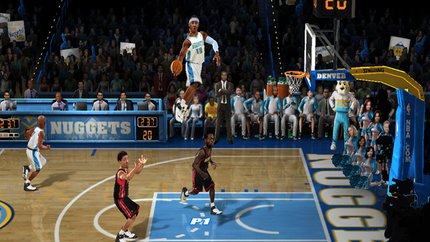
All told, we enjoyed our trip down memory lane with NBA Jam. The combination of new and old definitely has a balance that's more heavily weighted on the "old" side, but that's not necessarily a bad thing. The biggest flaw we could find in the game is its format: a retro experience like this seems tailor-made for the downloadable game space, but NBA Jam is retail-only. We'll see if EA reveals any more release plans further down the road, but in the meantime you can expect NBA Jam to arrive for the Wii later this year.
Source: Gamespot.com
Liberating a country, one headshot at a time. We take a look at City Interactive's upcoming stealthy first person shooter.
Whether sneaking through a crowded village hoping to avoid enemy contact, or seeking a vantage point to line up a shot on a high-value target, a sniper's job is always a difficult one. And while many modern military games give you a taste of what it's like to wield a high-powered rifle as a part-time killer, the upcoming Sniper: Ghost Warrior looks to put you in a ghillie suit and give you a taste of the problems (and power) that come with being a military sniper. 
Developed by City Interactive, Sniper will feature 16 missions that will add up to nine to 11 hours of gameplay. Though there are some straight run-and-gun assault missions to be found, most of your time is spent sniping. The game's plot takes place in the fictional South American country of Isla Truena, which has been under dictatorship rule. The US military is sent in to assist the rebels looking to overthrow the dictator, which is where you come in.
During our demo of the game, we watched as a sniper, wading through waist-deep vegetation, lined up a shot on two unsuspecting soldiers who were standing on the far side of a pair of cliffs spanned by a rope bridge. To set up a shot, you press the left trigger (on the Xbox 360 controller), which brings up the scope. The scope HUD has a lot of information--including the obligatory crosshairs, as well as a shifting red dot that is used on the easy difficultly level to show you exactly where your bullet will make impact (taking into consideration factors like wind and the natural arced path of a bullet's flight). At higher difficulty levels, that red dot is not available, and you'll be required to make the adjustments yourself. Another meter in the HUD measures your heartbeat; if your heart rate is normal (around 80 beats per minute), you're considered calm and can easily line up a shot. If you're under pressure and your heart rate is elevated, it will be more difficult to set up shots.
Much of the challenge of successful sniping isn't hitting the target, but rather getting into a suitable position that will allow you the best shot possible (while not getting caught in the process). In game terms, stealth is a big part of Sniper's challenge. Because many of the missions take place in the Amazon jungle, there will often be plenty of thick vegetation to hide in. You'll also have a handy meter at the bottom of the screen that will display how aware enemies are of your presence. If the meter fills up completely, you've been spotted and better look for an escape route. In some missions, you'll also have a spotter who will tell you exactly what you need to do in order to get through a mission. Finally, there's also a minimap that shows nearby enemies and their current state--calm, urgent, or alarmed.
In the sniping missions, you'll have a variety of gear to see you through to the end--most importantly your sniper rifle. You'll start a bolt action rifle but will eventually move on to longer range weapons like the Barrett, a significantly more powerful rifle that brings with its stopping power the added danger of being really, really loud. Enemies will respond to shots fired, after all, making every shot you take that much more important. There will be other accessories on hand in the game, including pistols, throwing knives (which you can pick up again to reuse), and claymore mines which you can use to set traps.
Different missions will have different requirements--some are straight-ahead sniping missions where the goal is to clear a village of enemies or take out a high-ranking officer. In others, you'll need to avoid enemy engagement altogether, and even being spotted by the bad guys will result in a failed objective. Some missions hold your hand more than others--such as those that use a spotter to alert you to nearby enemies--while others put the onus squarely on the player in dealing with all of the obstacles in your way; from planning, execution and, as looks to often be the case, dealing with missions that go haywire.
It's not all slow-paced stealth in Sniper, however; the game will have a number of assault missions to play through. In these missions, you're playing as an Army soldier whose missions are often tied to the sniper ops in the game. One mission we watched featured a full-on assault of a pair of oil rigs and, as you might expect, the action was frenetic and fast-paced, especially when compared to the slow-as-you-go sniper missions. In addition the game will include multiplayer, though details on the different modes haven't been released yet. 
Developer City Interactive says Sniper will be "the most realistic sniping experience in a video game ever," which, considering the long and illustrious history of sniping in games, is a heady claim indeed. We'll have to wait until we actually play the game before we can judge that assertion, but we do know that Sniper deserves some credit for putting so much of its attention on this most deadly of professions. The game is currently due for release in spring for the Xbox 360 and PC.
Source: Gamespot.com
Limbo First Look
Limbo is a hostile place to be in as we gingerly try to find our way through this twisted world.
Limbo is a concept that began six years ago and recently won awards for visual and technical excellence at the 2010 Game Developers Choice Awards. This striking black-and-white puzzle platformer is a tense and sometimes heart-pounding journey into a strange world where a young boy searches desperately for his sister. The game seems innocent enough at first, as you begin the game in a forest and the only sounds are the shuffling of your feet and the distant howl of the wind. The difficulty ramps up though, and the world is not as isolated as it seems. As the boy, you're nothing but a silhouette with two bright white eyes that stand out against the misty background. Like a traditional platformer, you're moving from left to right most of the time and you use the A button to jump and the X button to pull objects. What's interesting is that the game isn't split into levels, so there are no load screens after you start the game. There are frequent checkpoints in case you die, and you'll likely die quite often, but it's forgiving because you're never bumped back very far. The game is broken into chapters from the main menu, so after you've completed a portion of the game, you can jump around the different areas. But as you're playing Limbo, it's like a never-ending dream...or nightmare.
Puzzles involve figuring out what to do with the objects in your environment, whether it's pulling a switch to raise the water level or using a rope to pull down a log. Timing can be crucial as well because you can fall into plenty of traps. New mechanics will be introduced as you progress through the game. For example, we came across a glow worm that attached itself to our head, which forced us to continuously move in one direction and the only controls we had were to walk slow or walk fast. By moving under a light, the worm will fizzle and have a fit, forcing you to switch directions. At one point, we got caught in a spider's web, and when the spider returned, it spun a silk cocoon around us. We were able to get away, but because we were shrouded in the spider's silk, our moves were limited to little baby jumps until we got the web off. Our demo started off in a dark, creepy, and painfully still forest but jumped into a later level that was more industrial, with large gears, levers, and switches. The grating sound of grinding gears and saws were enough to keep us tense and focused on staying alive.
The atmosphere stands out the most, and the highlights of the game are the visuals and sound design. As you jog through the dismal landscape, leaping over bear traps and chasms, it sounds and feels as though you are truly alone--at least up until you come across silhouettes of other people who have created elaborate traps to stop you. But even then, they scurry away before you even get a chance to get close, and you're left with nothing but your wits and basic abilities to make it out alive. Giant spiders with grotesquely long legs will impale you if you aren't careful, and bear traps will snap you into pieces like a thin cracker. Even though you're nothing but a silhouette, the various creative death animations can be gruesome to watch. Impaling yourself on a branch, falling onto a circular saw, or getting squashed on a conveyer belt are just some of the painful ways to go. But what comes after that is what will make you squirm, whether it's seeing the leftover black goop on the machines or watching the boy's head fly off in the opposite direction of his legs. Every once in awhile, we came across a fluttering butterfly and for one brief moment, an image of a young girl, which reminded us of why we were going through all these dangerous hoops in the first place. There is no narration, no voices, and very minimal music, so it truly feels like you're navigating through a gloomy painting taking one careful step at a time. Limbo is set to be released sometime this summer on the Xbox Live Arcade Marketplace. We'll be sure to update you with more information as soon as it becomes available.
Source: Gamespot.com
We prowl through the mountains of Afghanistan in EA's upcoming military shooter.
Hearing executive producer Greg Goodrich describe things, you'd wonder why a developer would want to use military advisors at all. He had just finished showing us a demo for the upcoming Medal of Honor reboot. It was a tense scene from early in the game--a group of Navy SEALs prowling though the Afghan mountains under cover of darkness. More than anything else, the sequence seemed intended to show the surgical precision with which these elite Tier 1 soldiers operated. Characters slid from one al Qaeda campfire to the next at a pace that was nothing short of brisk, dropping enemies before they heard the M4s go off. It was a ruthless level of efficiency on display, and it seemed that the only things keeping the player from falling behind--or off a cliff--were the objectives whispered from his squadmates. So, of course, when EA Los Angeles showed the demo to real-life SEALs, their only feedback was that they'd never speak a single word during a mission like this one. Silence is golden.
Such are the challenges of developing a game where the primary goal, according to Goodrich, is authenticity. There's a difficult balance to strike between what paints the most realistic picture of special military operations and what works as a fully functioning video game. Finding that balance has meant developers have had navigate the murky waters of a give-and-take relationship with the very Tier 1 operators depicted in the campaign. Sometimes, the result has been taking things out of the game that these elite soldiers can't afford to make public, and at other times--like the example mentioned above--the development team has had to politely disregard feedback in order to keep the game playable.
But for all the hiccups or roadblocks in this relationship, Goodrich says the developers have been able to draw from a mountain of helpful advice and stories. Case in point: The aforementioned demo is based on a real military operation, described to EA LA by some of the SEALs involved in it. It's the night before a major offensive, and the plans call for a group of army ranger cargo helicopters to pass through a particularly dangerous mountain range in Afghanistan. As part of a SEAL unit, you're sent in beforehand to eliminate a number of targets to give those Chinook helicopters a safer flight. An easier way of putting it might be this: You need to soften them up a little.
Goodrich likes to use the catchy phrase "scalpel and sledgehammer" to talk about missions like these. You have to lurk through the darkness to methodically take down unsuspecting enemies, and once you've loudly announced your presence by blowing up their antiaircraft guns, there's suddenly AK-47 gunfire cutting through the nighttime quiet like an angry swarm of bees. According to Goodrich, that's how real life Tier 1 operations work. At any moment, you can go from precise and deliberate to utter chaos; thus, keeping your cool in those jarring transitions is what matters most.
 Fortunately, you've got advanced technology on your side. Toward the end of the demo, you see a fleet of enemy trucks coming up the pass. It looks as though these heavily armed vehicles are going to spell failure for your mission. But if you flip down your night-vision goggles to get a better look, you'll see a flashing strobe light on each truck. Off in the distance, a friendly airship fires a missile at this caravan and immediately wipes it out of the picture. Without any context, it seems like you've just been rescued by the military equivalent of magic and pixie dust. But as it so happens, those strobes were carefully planted by a different playable unit in an earlier level. That gradual intertwining of various Tier 1 missions is a key part of Medal of Honor's narrative. And as an example that "narrative" doesn't have to equal "fiction," Goodrich quickly points out that those strobes were planted in the real-life mission as well.
That's one of the more obvious ways EA LA has drawn from this military advisory relationship. After the demo wrapped up, Goodrich told us about some of the more subtle bits of feedback that have been incorporated into the game. If you glance at the cover art, you'll see a real-life Tier 1 operator sporting a thick, impossibly manly beard. He's not just there for looks. This soldier is responsible for switching up one of the most overlooked parts of a first-person shooter: the hands holding the gun. When EA LA brought him footage of handgun combat, he abruptly noted that the player was holding his gun like a cop. That led to the realization that various units within the military will often employ different gun holds from one another. This is all a long-winded way of saying that you'll see different hand configurations on similar weapons as you bounce between military branches in the game. It's one of those subtle things most people probably won't notice, but it's an interesting example of the team's focus on details.
 Driving all of this is a heavily modified version of the Unreal Engine. Medal of Honor's matter-of-fact presentation is a far cry from recent EA games that have used this tech to render highly stylized visuals (think Mass Effect 2), but the art design isn't without its striking ambitions. If you climb your way up one of the game's mountain perches, you'll be greeted with an impressive vista showing the sprawling valleys and peaks of Afghanistan's mountain ranges. These views capture a nice sense of scale, which should hopefully give the final game the feeling that you're just one man--however highly trained--in a much larger battle.
At this point, we're looking forward to seeing some of the other parts of the war in Afghanistan that this latest Medal of Honor will seek to portray. We're told that the final game will offer up missions that are set in dusty mountains, urban slums, and even some lush environments that few would recognize as Afghanistan. In the meantime, you can expect Medal of Honor to arrive this fall.
Source: Gamespot.com
2K Games and Firaxis finally show Civilization V at GDC 2010. Get the details here.
For years, the Civilization series has challenged players to assume the role of one of history's greatest leaders, such as Napoleon Bonaparte or Genghis Khan, and try to conquer the world through force of arms, scientific research, or overwhelming cultural superiority. And for years, the series has been synonymous with things like turn-based strategy, insidiously addictive gameplay, and the compulsion to explore every last square on the map. Except that with Civ V, you won't be exploring squares. You'll be exploring hexes. Yes, as you've probably heard, the new version of Civilization will make some noticeable changes to the series, including changing how maps will be divided not into four-sided squares, but into six-sided hexes, and how archers and other ranged units will actually be able to fire on their enemies from more than one hex away (previously, all units did battle by getting adjacent to their targets). These are big changes, but from what we've seen, they not only seem plausible enough to work, but also seem like they'll open up lots of new strategic possibilities. (Which means, you know, more of those sleepless nights.)
We saw Civ V in a hands-off demonstration at the 2010 Game Developers Conference in San Francisco, in the early settlement game, as well as in a later, more-established session against more-developed nations. Civ V's interface is being designed by Firaxis staffer Russell Vaccaro, who also contributed to Firaxis' previous console Civ game, Civilization Revolution. Like that game, Civ V will have a highly streamlined interface that keeps a lot of the information off the main map view in favor of showing the game's detailed 3D world. From a technical perspective, Civ V's overland maps look better than they ever have and feature realistic-looking forests, mountain ranges, and flowing water in the form of inland rivers and sparkling oceans.
 While you're gazing from sea to shining sea, you won't have to stare at piles and piles of numbers and icons--instead, while you'll still be able to access menus like your city's build menu, the scientific technology tree, and your diplomacy standings with other nations, they'll all be nested in menus that can be quickly and easily closed up. To make sure you don't forget what you were going to do next, the game will instead offer an enhanced notification system that will alert you to pretty much all happenings in the game, from completed scientific research to finished construction in your cities to discovering ruins (which appear to be the new game's version of goodie huts), and clicking on the notification will always open up the relevant menu and let you do whatever you need. In addition, Civilization III's advisors return in Civ V and will, as usual, offer you helpful tips on the next move you might want to make.
The demonstration we watched showed an early starting game for Greece with a troop of settlers (which act as the single settlers unit from previous games) and a troop of warriors (which act as a single warrior unit from previous games). The settlers immediately started a new city, while the warriors headed out into the wilderness to find a neighboring city-state, one of Civ V's new features. City-states are basically neutral cities of varying specializations (such as a militaristic city-state) that can be conquered if you prefer, though you can leave them neutral and form treaties with them, or take missions from them. Forming a strong relationship with a neutral city-state can be very beneficial--becoming buddies with the militaristic city-state in our demonstration meant that the neutral burg would send us free warriors every few turns--but it can also upset nearby civilizations who would prefer to have that city-state's services for themselves.
 Expansion will still be crucial to your success in Civ V, and the amount of "culture" your nation produces will still be the determining factor in how often your cities expand, but this time around, cities will not automatically expand outward in giant concentric circles. Instead, your holdings will expand one hex at a time and will tend to automatically grow toward specific nearby areas that your current civilization needs--for instance, if you've been developing your agricultural base, your nation will automatically tend to expand toward that nearby wheat-growing plain. While you can still use the old trick of annexing nearby resources by just sending out a settler to build an adjoining city nearby, there will apparently be game-specific disadvantages to having two cities too close to each other. Instead, Civ V will offer you a new alternative to send settlers to a desired area and plunk down a huge sum of gold to simply annex that zone and its resources.
After observing the early ages, we skipped ahead to a more-developed version of Greece that lay near holdings from Germany and the good old U. S. of A. Our first encounter with Germany came in the form of greeting a German settler, which brought us an audience with Chancellor Bismarck in his private chambers. Meeting with world leaders will look and sound different in Civ V, since the game will switch to a full-screen view of that leader in his or her current environment (whether that be in a home office or out at war, for instance), which shows more or less a full-body view of the leader as he or she paces about the room, smiling (or frowning), gesticulating, and speaking his or her native language.
 That's right, leaders will no longer be mute mimes who make grandiloquent genuflections in your general direction--Chancellor Bismarck will speak full-on German, while General Washington will speak perfect English. This is a new change that Civ fans have apparently been requesting for some time. In addition, while you'll still be able to negotiate trade agreements, travel agreements, and peace treaties with neighboring nations, Civ V will also let you enter into research treaties--essentially, a joint investment of a lump sum of cash that will accelerate scientific research for both nations. This can be a highly beneficial arrangement that earns you friendship points with other nations, and it can also be a serious bone of contention if you cut the treaty short midway.
In this session, after exchanging pleasantries with Bismarck, we set about making overtures to a nearby city-state along the American border. While we definitely made some friends there, General Washington of America didn't seem quite as happy and addressed us in a cordial but stern manner when we sought an audience with him. For the sake of the demo, our Firaxis hosts went ahead and declared war on the indignant dignitary, and we had our chance to observe Civ V's tactical combat in action.
Civ V, as mentioned, is making some significant changes to the way combat works. For instance, the combined armies of the previous games are a thing of the past--instead, only one "stack" (a single battalion of troops that occupies any given hex) can occupy a hex. No more combining units to make them stronger. In addition, units will take longer to produce and will eventually come to have upkeep costs associated with them--however, they will also have veterancy along the lines of what was introduced in Civ IV. That is, units that survive various skirmishes will eventually grow in power and may be able to select various bonuses to increase their usefulness and survivability. The Firaxis team, led by designer Jon Schafer, envisions more-intimate, tactical battles in Civ V (based on Schafer's fondness for the classic Panzer General)--generally speaking, you and your neighbors will have fewer military units in play than you might have had in previous games in the series, and they'll last longer and be more valuable.
The combat demonstration we watched showed a land invasion of America along two fronts, with enemy spearmen guarding General Washington's town on both sides. Our ranks consisted mainly of warriors, spearmen, and a few archers, and though our relatively weaker warriors unfortunately started on the front lines ahead of our spearmen, we were able to use Civ V's new switch move order to have the two units swap positions, and then we pit our spearmen against theirs. Those crafty Americans set themselves up behind a river, which gave their units a natural terrain bonus, but we softened up our foes with a volley of arrows from a stack of archers placed atop a nearby hill. By softening up our foes and weakening their remaining health, we effectively reduced their terrain advantage and were able to mop them up with our own spearmen, which were at full strength. Meanwhile, on the western end of the border, our troops encountered worse luck. Washington had built his empire around a one-hex-wide choke point in the mountains and blocked it off with spearmen backed up by archers. Because only one unit can occupy any one hex at any given time, there was no way to pass through the mountains without going through the enemy spearmen--cases like these will require your own archers (and other ranged units) to soften up the front lines. However, archers themselves will be extremely fragile and can be easily decimated if they're engaged in hand-to-hand combat.
 And as it happens, in Civ V, units may no longer be garrisoned inside your cities, so defending your holdings will have two aspects. One--all cities will automatically defend themselves based on their current growth level and any defensive structures you may have built inside. Two--you'll want to make sure you defend your key cities with army units, possibly building fort structures nearby to enhance your defenses. This task may or may not be as impossible as it sounds since Civ V's "conquest" victory condition has been tweaked to require you to capture all enemy capital cities, as opposed to capturing every single city on the map. Again, these are big changes and are really pretty bold--but they seem like they could add real depth and exciting new direction to the series. Oh, and one last note--although Civ IV's religion system (which was met with mixed reactions) won't be making a comeback, we're assured by Firaxis that the feature wasn't simply cut without any plans for other new features to replace it. There are definitely more changes afoot for Civ V, and we can't wait to find out more. The game is scheduled for release later this year.
Source: Gamespot.com
True Crime First Look
The third game in this sandbox action series has you exploring Hong Kong as an undercover cop.
If you're the type of person who enjoys video games as a form of escapism, then you may have found the first entry in Activision's True Crime series a bit of a head-scratcher. Of all places, the game was set in Los Angeles--otherwise known as the most frequent butt of jokes about traffic jams and endless urban sprawl. While the game itself proved to be a fairly entertaining action romp, it's hard to deny that the setting could have been a tad more exotic. It's a different situation, however, for the upcoming True Crime reboot from United Front Games. Set in the vibrant metropolis of Hong Kong, the next True Crime--this one free of subtitles--has you taking on the role of an undercover cop attempting to infiltrate the notorious Triads that plague this dense and colorful city. When it comes to open-world action games like this one, the city itself can be just as important as any member of the cast. While we weren't able to play the game and thus explore the city at our own leisure, it seems that based purely on the visuals True Crime's version of Hong Kong has got character to spare. The outdoor nighttime environments are flush with color, with paper lanterns strewn between buildings and a rainbow of neon lights on every building. Other environments in the game include windy hills leading up to scenic overlooks and large stretches of water connecting the city's various islands.
True Crime will offer up the familiar trio of driving, gun combat, and melee fighting that other games in the sandbox action genre are built around. What looks to set True Crime apart from others, though, is the stylish way those actions are carried across on the screen. United Front is aiming to make True Crime feel a lot like a slick Hong Kong action movie, as the 2002 thriller Infernal Affairs was a frequent point of comparison when we spoke with the development staff.
The melee stuff is what grabbed us the most. The game's main character, Wei Shen, is clearly a man who knows a few things about martial arts. As he went about his mission trying to infiltrate a warehouse in the industrial area of town, the hand-to-hand skills he used to dispatch enemies were the highlight of the show. There was a lot going on, including grapples, counters, and reversals. All those rapid-fire movements were animated fairly well and the combat moved at a fast clip. With sweeping leg attacks, as well as the ability to quickly run and vault over objects, Shen was able to keep blazing through the mission without having to get his hands too dirty.
The way environments fit into melee combat grabbed our attention as well. These location-contextual attacks are pretty brutal, including the ability to slam someone's head in a refrigerator door and throw a guy into a dumpster mid-grapple then push him into an electrified circuit breaker. Handheld weapons are vicious, too. At one point, we saw Shen snatch a meat cleaver from an enemy's hands and deftly wield it like a dagger before plunging it into someone's chest. A moment later, he stole the gun from another enemy and quickly spun him around to shoot the back of his knee in one quick motion. Once you transition into full-blown gun combat, True Crime begins to look a bit more ordinary. Everything is in there that you'd expect: a cover system, explosive barrels, and a good selection of black-market weaponry. But compared to the melee fighting, there doesn't seem to be anything terribly unique about the shooting aspects of the game. Then again, we didn't get to see a whole lot of gun play, and according to United Front, there's a somewhat unique nonlethal targeting system that lets you aim for limbs in order to take out enemies without killing them. While we didn't get to see that part, the promise of this seems like an interesting way to explore Shen's status as an undercover cop stuck in a morally ambiguous situation.
Finally, there's an entire city's worth of vehicles for the taking. Among other options, you can plow through cramped markets in SUVs or zip around the crowded streets and alleys on nimble motorcycles. But it doesn't seem like the selection of vehicles is the eye-catching part so much as what you can do with them. Our demo ended with a bizarre and improbable motorcycle feat: Shen sped up behind a quickly moving car then effortlessly leapt from the motorcycle to the fast-moving sedan as if it were nothing. When you combine that with the slick melee system, you've got a pretty good idea of the stylized gameplay that United Front is aiming to deliver. How it all comes together is something we should have a better idea about as we get closer to True Crime's fall 2010 release date.
Source: Gamespot.com
As far as sweeping proclamations go, the claim that Lara Croft practically invented the modern action-platformer is pretty low on the controversy scale. It's hard to argue against the idea that recent hits like Uncharted and Assassin's Creed owe a large debt of gratitude to Ms. Croft's Tomb Raider series for helping to usher in today's era of jumping, climbing, and shimmying across three dimensions. So when you hear about the next game bearing her likeness, it's entirely understandable that you may let out a guffaw or two. But here it is: Lara Croft and the Guardian of Light, due for release as a digital download this summer, is an arcade-inspired action romp with a fixed isometric camera and a focus on high scores and replay value. Though the genre is something out of left field, this latest Lara Croft adventure looks to maintain much of the feeling of earlier games (tombs, booby-trap puzzles, and so on) with a framework designed around cooperative adventuring.
On a story level, Guardian of Light is a buddy adventure starring Lara Croft and Totec, a Mayan tribesman. The plot is lighthearted Hollywood fare and tells of the Mirror of Smoke, an artifact whose ancientness is matched only by its mysterious powers. And as people tend to do with mysteriously powerful artifacts, a number of folks are fighting over this thing. The odd couple of Lara and Totec find themselves in a battle against Xoxolt, an evil spirit released from the Mirror who has the distinct advantage of controlling all manner of spirits to do his bidding. Expect to be going up against undead tribesmen, giant salamanders, and from the looks of it, everything in between.
But for this downloadable game, the focus falls less on story and more on uncomplicated gameplay. As the point totals erupting from dead enemies suggest, this is a game with one foot in the 1980s. Beyond that, there's also the fixed isometric camera angle. Moving through Central American jungles and temples, you'll always see the action from the same semi-top-down perspective. This keeps the focus squarely on the torrent of enemies capable of swarming you at any given moment. It's a set-up that leads fast-paced yet simple combat: point your weapons at the things you want to die, shoot, and repeat. It's hard to draw any clear comparisons due to the fact that we weren't able to play the game, but the combat definitely gave off a retro, where-did-I-put-that-quarter kind of a feel.
Each playable character has unique weapons and skills for maneuvering through those Central American jungle ruins. Lara's got her iconic dual handguns (which, befitting of the retro style, have infinite ammo), and Totec hurls deadly spears. But these weapons aren't used purely for combat. For example, the spear works both against enemies and as a tool for traversing past obstacles: Totec can throw a spear into a wall to allow Lara to get up to an otherwise unreachable ledge. Lara, on the other hand, has a grapple hook to make it across seemingly impossible gaps, and Totec often must place his life in her hands with assisted jumps. Other co-op tricks include Lara's ability to jump on top of Totec's shield when he holds it above his head and Totec's tightrope walk across a gap using Lara's grapple rope.
You'll also encounter a number of tombs to explore. These indoor caverns offer up the chance to take a break from the frenetic combat to do some old-fashioned puzzle solving. Think booby traps that can only be overcome with two people working as a team, and you've got a good idea for how these puzzles will function. This co-op system will work both online and locally, featuring a drop-in system for adding a second player on the fly. The whole game can be played using a single player, as well.
Contrasting the old-school game design are Guardian of Light's modern visuals. Vegetation sways in the wind and reacts when you walk through it, while the environments have a nice sense of scale when the camera shows you at the top of a platforming sequence that's meant to spiral downward toward a point far below. Those looks, along with the co-op stuff, are some of the big points working in the game's favor. At this point, the big question remaining is how the game plays. Expect to see some hands-on coverage leading up to Lara Croft and the Guardian of Light's summer release.

