CiNG, the team behind cult hit Hotel Dusk, return with another murder mystery, but this one's an interactive crime novel better left on the shelf.
Developer CiNG carved out a nice niche for itself before folding under bankruptcy a few months back. Cult hits such as Trace Memory and Hotel Dusk: Room 215 tapped into a completely different handheld experience than most were accustomed to playing on DS. The development team’s efforts have become synonymous with “book-style” DS games that forced you to play with your system turned sideways. The team’s latest project, Again, is one of the team’s final projects, and could very well be the last game of theirs to hit the US. While it offers many of the ideas and concepts that made games like Hotel Dusk so attractive, it falls far shorter in execution. 
Like those other games, Again is an adventure game that plays out like a crime novel. You play as Jonathan “J” Weaver, an FBI agent who discovers that he has (or is it that he suffers from?) clairvoyant abilities to that allow him to simultaneously see past and present crimes. J and his partner Kate are in search of Providence, a serial killer who went on a short but brutal murder spree 19 years prior. Providence’s calling card was a cut-out Eye of Providence from dollar bills, which he was left at each murder scene. Nearly two decades later, a similar strain of murders -- seemingly directed at J -- are striking the city, which somehow is connected to his past., and they’re connected to the past.
Previously On Again…
Similar to Hotel Dusk, Again uses a stylized aesthetic to portray its crime-fighters. Though CiNG’s previous hit used pencil-drawn animation a la A-Ha’s “Take on Me” video to depict its noir-inspired world, Again uses real actors to provide a sense of TV-crime drama realism. Although it doesn’t always work -- characters have a limited number of stock animated gestures and the camera pans back and forth between them in a highly jarring fashion -- it gives the game a visual sense of CSI-esque urgency. Factor in a TV-stylelike recaps and five-secondbrief cinematic sequences in between chapters (or when re-loading a save file), and it begins to s best moments feel like you’re participating in a detective show.
Without spoiling the plot too much, each of Providence’s crime scenes is structured like a stage. As you discover the events of the past, a connection to the successive murder opens up. J’s psychic abilities are the main hook of Again. Once you’ve finished questioning witnesses and victims’ family members, you enter the location of the crime -- usually conveniently preserved since 1991 -- and through careful deduction, piece together the killing as it occurred. Mechanically, the deduction splits the action into the past (left screen) and present (right screen). Your mission is to scan the latter-day scene for psychic links to the old-time locale. It’s a unique idea in theory, and starts off with plenty of promise.
Psychic Powers Couldn’t See This Coming
Unfortunately, it becomes the root of Again’s issues. When crime investigations work well, they flow together in a relatively intriguing fashion that evokes the thrills of other great DS adventure games. But more often than not, I wandered the murder scene scanning for related clues, and the mechanics failed me more frequently than they aided. J can search a room, but if he mis-scans five items, he dies. While the game is lenient in allowing you to restart if you kill him, you’ll probably murder him more often than you’ll successfully execute a clue-unlocking puzzle.
The camera and movement around the 3D space feels clunky and unnecessarily complicated to maneuver. Although many handheld games in the adventure genre have the quirk of shoehorning you into solving a mystery on their terms (see: Ace Attorney), Again exacerbates those quirks to the point that it devolves into a bland exercise in “match the objects” at best and dysfunctional gameplay at worst. If the supporting experience were was stronger, it would make these troubling moments more tolerable. But as it stands, Again’s crime scenes are wildly uneven, which is a shame, since it’s the anchor of the experience. 
Unfortunately, the rest of the game fails to prop up Again’s weak hook. Whether it can be attributed to bad localization or the original Japanese plot is being truly tepid, the game’s dialogue is dull as dishwater and does little to engage the player past an early eyebrow-raising plot revelation. The story progresses, but doesn't grip with nearly the level of tenacity seen in CiNG's prior games. When a genre that's known for slow burns delivers a game with all of the heat of rubbing two sticks together, there's a real issue. Despite the initially appealing aesthetic of the game, Again wears out its welcome within a few hours of play, and honestly, there’s little that’s engaging enough to bring you back to it.
CS-Why?
After CiNG’s strong efforts in the genre, it’s sad to see that a game with the potential to deliver another distinctive handheld experience would flounder so much. While Again's sleek prime-time crime drama aesthetic is appealing and, the initial crime investigation moments show off potential, and an early plot twist show off lots of initially grand potential, the game goes on to squander it with dull dialogue that never picks up, choppy pacing, and misfiring mechanics. In this case, the shortcomings far outpace the best attributes of the experience. After several years of great adventure games on the DS, it’s truly shameful to see Again fall so short of great possibilities.
Again Review
Sci-fi trappings don't make the repetitive gameplay in this dungeon crawler feel any less dated.
Since its inception, the Megami Tensei franchise has weaved elements of science fiction with fantasy stories to craft rich worlds steeped in the occult. With the release of Shin Megami Tensei: Strange Journey, developer Atlus has taken a slightly different approach with a story that is much more focused on science fiction than previous entries. Despite this shift in direction, however, Strange Journey is still a game firmly entrenched in the past. Longtime Megami Tensei devotees may be thankful for its return to the first-person dungeon-crawling roots of the series, but those expecting this to live up to the superb Persona 4 or Devil Survivor will be disappointed with the outdated gameplay, straightforward combat, and boring exploration of Strange Journey. 
At the tip of the South Pole, a mysterious black spot that consumes everything within its boundaries has appeared. This spot, dubbed the Schwarzwelt, is observed to be expanding uncontrollably; thus, a multinational team of soldiers and scientists armed with the latest weapons and technology have been sent in to find a way to stop it. After crossing through the threshold, you learn that the Schwarzwelt is actually the gateway to a world of gods and devils fed up with the human race. After an accident traps you inside with demons who endlessly expound on how mankind has squandered and abused their planet without a shred of subtlety, it's up to you and your ship's crew to save the world and escape.
As an American soldier, you spend most of your time securing the various sectors that are found within the Schwarzwelt; each of them a twisted facet of the human world. Gameplay consists primarily of first-person exploration through these mazelike areas which, over time, become increasingly complex. They are also booby-trapped with pitfalls, moving floors, damage tiles, and the like. To survive the bland, repetitive, and presumably harsh environments in the Schwarzwelt, you're equipped with a suit of demonica armor. This set of prototype combat gear automatically maps your movements, and helps you uncover hidden passages, enemies, and items through various subapplications you install. Though the demonica proves invaluable, even with all of its utility, you still often find yourself wandering around aimlessly. There are times when your map does not show you where to go next and your list of objectives doesn't clearly communicate what to do, and so you have no choice but to stumble around looking for hidden passageways or the next story event. This is particularly frustrating if you return to the game after a break and forget where you are.
One area where your demonica does excel, however, is in facilitating interactions with the resident demons of the Schwarzwelt, whether they are violent clashes or philosophical debates. Depending on your equipment, you have a variety of attacks at your disposal to dispatch your enemies, but things don't always have to go down that way--some demons are open to talk. The demon negotiation system--most recently seen in Shin Megami Tensei: Persona on the PSP--has returned once more, allowing you to bribe, wheedle, or scare adversaries into becoming allies. Though this gameplay mechanic was fresh and innovative when it was first introduced well over a decade ago, it's no longer particularly exciting to figure out which of the multiple choice responses you're given will gain a demon's support or its ire. The system hasn't significantly changed in recent years, and dealing with demons in such a passive manner is neither engaging nor intriguing.
Regardless, successfully drafting demon allies means you can summon up to three of them to fight alongside you against their hostile neighbors in the turn-based combat system. Each demon has their own strengths and weaknesses, and so it's necessary to constantly tweak your party to ensure the optimal team depending on the situation. Demons aren't only meant for fighting, though--your recruits can also be fused together to create new, more powerful allies and to pass on special skills and abilities. You can even share your creations with your friends by trading passwords. 
Strange Journey features a wide variety of demons to fight, recruit, and customize through fusion, each of which has its own meticulous artwork and animations (though some are reused from previous Megami Tensei games). Likewise, dungeon tile and texture art is highly detailed, though it unfortunately loses its luster due to the repetitive nature of the dungeon-crawling action. Veteran series maestro Shoji Meguro returns to score Strange Journey, and like other aspects of the game, his compositions shift slightly away from the norm to fit the sci-fi plot and settings quite well.
Shin Megami Tensei: Strange Journey may be the latest entry in the venerable franchise, but its outdated demon negotiation system and tedious dungeon-crawling action might have you think otherwise. Longtime series fans will no doubt appreciate its return to form for the dozens of hours its appropriately dark story will occupy them, but neophytes--especially those expecting something similar to games like Persona 4--are better off staying away.
Source: Gamespot.com
A few flaws hold it back, but the latest Settlers game is the series' most charming to date.
The little workers that follow your orders in The Settlers 7 are a tireless lot. They mine for coal, shear sheep, chop wood, and smelt iron yet ask for so little in return. In fact, if you don't have anything for them to do, they might cry out for a little work to ease the burden of their own laziness. And when you play this economy-heavy strategy game, you'll be just as busy--and content--as these tiny computer people. The latest in the long-running Settlers franchise is as charming and enjoyable as past installments, though it's hard to escape on-again, off-again online troubles that have plagued the game since release. Even if you are only interested in The Settlers 7 for its single-player features, you have to be connected to the Internet and signed into Ubisoft's online portal to play. Unfortunately, server problems occasionally make the game inaccessible for hours at a time, which is an issue that does not appear to be improving as the weeks pass. 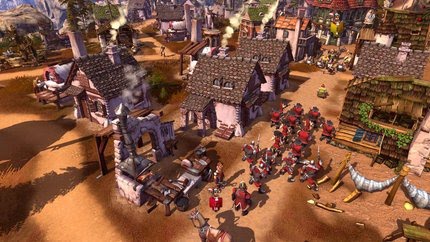
If you're the patient type, however, you'll probably want to put up with the ongoing connectivity issues simply because The Settlers 7 is fun to play. It isn't as complex or as varied as similar offerings--Dawn of Discovery, for example, or even previous Settlers games--but it has a mesmerizing flow that has a way of pulling you in. The game is all about setting up supply lines by building appropriate structures and abodes in the appropriate places, and then balancing the stream of resources that your settlers then automatically collect. Then you expand your realm across the map by taking over connected settlements, whether they be neutral or already taken by an opponent. The campaign starts you off slow, introducing you to concepts one by one, but in time, you discover just how complex the economic web can be. For instance, you need wood to make planks, which are in turn used as a basic building material for standard structures. Your armies require fancy food, which means you need to build lodges near forests teeming with wildlife or build piggery extensions onto your farms. Then, you need to make sure to attach a butcher annex onto a noble house--which itself requires regular food to operate.
This sounds complicated, but it's easy to get the hang of, and the game does a good job of pointing out gaps in your economic chain. If your mints aren't pumping enough gold into your coffers because you are low on the coal they need, a little icon will appear over the building in need to let you know. Matches can be challenging nonetheless, and resource imbalances may require you to approach things a little differently every time. For instance, you might need to gather wood on barren land. In that case, you need to add a forester annex to a lodge, and because main structures can only have three additions attached to them, space restrictions can become a concern. If you find there aren't many gold mines to empty, you can make beer to sell at your tavern, though then you are redirecting a resource used to attract clerics to your realm. You're constantly forced to make adjustments throughout the course of a single match, and failing to pay attention can have disastrous consequences.
There are times when you'll wish the game made it easier to keep track of things. In a typical match, you'll start expanding your kingdom quickly, and space restrictions might require you to place important structures in settlements other than your primary one. In time, it can become a burden to keep track of a stronghold (for creating troops), a church (for producing men of the cloth), and an export office (for hiring traders). Hotkeys or icons that let you quickly jump to these crucial buildings, along with your all-important tavern, would have been incredibly helpful. As it is, you need to remember where you placed such structures, and when you scroll to that settlement, you must be able to visually identify the structure in question so you can click on it. Other interface improvements would also have been welcome (being able to click on the icons in the build queue to jump directly to that structure, for example), but some flaws aside, it's easy to get around the map by scrolling or clicking on various nodes on the skeletal minimap. If you scroll all the way out, you'll switch to a helpful bird's-eye view that shows you where resources are located, the status of the opposition's expansion, and other helpful tidbits. 
Armies provide the most straightforward way of expanding, and you'll easily crush the neutral armies that protect most unconquered settlements. There's nothing complex about combat; you just click on an army, click on a sector to attack, and off they go. Battles are an automated affair that comes down to sending enough of the right types of troops. Once you've gotten your economy going, you might have multiple armies moving about, each led by a different general, but military might doesn't mean easy triumph. You can win by vanquishing your enemies' primary hubs, but most of the time, you'll overcome your foes by earning a set number of victory points. You might earn a victory point by having more gold than your adversaries, earning more prestige (accumulated by placing prestige structures like statues), or capturing specially designated villages, for example. This system provides flexibility and a bit of unpredictability, and the resulting tug of war is tense and enjoyable.
You'll want to start with the campaign, which helps you get up to speed on all the economic intricacies. The straightforward story is buoyed by Princess Zoe--and her excruciating French accent--who must yank the land of Tandria from the clutches of some flamboyantly histrionic enemies. Missions begin with lovely pop-up storybook updates, occasionally punctuated by impressive and colorful cutscenes. These highlights help make up for the not-so-subtle plot development you'll see coming from the beginning, though the campaign is really just an extended tutorial for the more substantial multiplayer and skirmish modes. In skirmishes, the AI provides a decent challenge and does a good job of adapting, and while there aren't a whole lot of maps, you can edit them in various ways (change victory conditions, for instance), which keeps things somewhat fresh. If you want even more adaptive competition, you can head online, where both ladder (ranked) and unranked matches await. Online play is smooth and matches are of a goodly length (often over an hour), but you might have trouble finding games online.
Vibrant colors and a somewhat goofball art design make The Settlers 7's lush forests and ghost-ridden swamps leap right off the screen, and the animations make the game as fun to watch as it is to play. The exaggerated movements of your miners as they hop into a mining car are delightful; even constructors exude endless charm as they bound toward their destination. There is a distracting blur effect used on more distant objects, though it seems more noticeable at certain resolutions and can be hard to get used to. The wonderful soundtrack provides a nice complement to the sun-drenched visuals, featuring light orchestral fare, a bit of harp strumming, and even some Celtic-inspired vocal warbles. 
Some of The Settlers 7's more interesting features are the peripheral ones. You can customize your castle with different ornaments, windows, flags and such. An integrated achievements system lets you post your accomplishments to your Facebook profile if you so wish, while you can call on another player for assistance with the click of a button. The flipside of this social friendliness, of course, is the inherent unfriendliness of an unstable online-only copy-protection scheme. That drawback and others aside, The Settlers 7 offers something for everyone, whether you're an experienced armchair economist or just like watching little virtual people run up and down the roadways carrying pails of water.
Source: Gamespot.com
Shatter Review
Shatter is brick breaking at its best--simple, innovative, and beautiful.
The simple concept of brick breaking as the basis for a video game is almost as old as video games themselves. Breakout first came to home consoles more than 30 years ago, captivating countless players with nothing but a paddle, a bouncing ball, and a ton of bricks. Shatter breathed new life into this old concept when it was released for the PlayStation 3 last year, and now it has come to the PC. Shatter's numerous innovations, coupled with gorgeous visuals and an exceptional soundtrack, make it feel not so much like a step forward for the brick-breaker genre as a bold reinvention of it. 
In Shatter, you control a small machine called a bat that has a convex surface and the ability to move along only one edge of the playing field. As you guide this plucky little mechanism in its quest to overthrow its oppressors, you'll encounter wave after wave of bricks impeding your progress, just crying out to be destroyed. Luckily, you have just the thing to get the job done. The bat can fire a ball capable of breaking the bricks that stand in your way, and your goal is to keep the ball in play as long as possible, sending it on a collision course with bricks that need breaking and not letting it get past you when those same bricks send it back your way. The allure of this well-worn action lies in its simplicity. There's an unfettered purity to the gameplay that can lure you into a state of profound focus, where all that matters is keeping the ball in play and increasing your score. When you're fully absorbed in the action, it's very exciting.
The additions Shatter makes to this tried-and-true formula are remarkable because they introduce compelling new elements to the gameplay without distracting from the simplicity at its core. The most significant of these is the ability to suck and blow air with the bat, making minor adjustments to the ball's trajectory and vacuuming fragments of shattered blocks that fill up a special attack meter. This gives you a level of control over the action that extends beyond the bat itself and keeps you involved at all times--not just when you need to get the bat into position for a rebound. And if you like to live dangerously, you can launch two or more balls to ratchet up the challenge and increase your score multiplier. It's a cool risk-versus-reward option that is at your disposal at any time, so long as you have more than one ball to spare. There are also a few power-ups that significantly change the action when you collect them. Unstoppaball turns the ball into a destructive juggernaut that has a momentum oncoming bricks can't interrupt, while manueveraball makes the ball much more susceptible to the influence of your blowing and sucking, which lets you precisely steer the ball toward your intended target.
Shatter's inventiveness also spreads to level design. With horizontal, vertical, and even round level layouts, the position of the bat and the way the ball ricochets about the area is constantly shifting, which prevents levels from feeling too similar. There's also a great variety of brick types, including bricks that take several hits, bricks that try to blow the ball away, bricks that blow up other bricks around them, bricks that creepily multiply, and bricks that drift about in the contained atmosphere of the level. These last bricks mentioned can be quite a threat. If one of these loose bricks collides with the bat, it'll be knocked out of play for a brief moment, which can, of course, be deadly if you fail to catch the ball as a result. Thankfully, you have a shield that can protect you from these bricks, but using it drains the meter for your special attack, which is called the shard storm. This attack rains a devastating shower of shards on the bricks or boss in your way, which can be quite useful in a pinch. 
Speaking of bosses, each of Shatter's 10 worlds culminates in a boss battle, and most of these showdowns are thrilling and memorable. Each boss has a weak spot that you must attack with the ball, but introducing the ball to that weak spot is invariably easier said than done. You battle a clocklike machine with rotating arms that threaten to knock the ball away; a few menacing contraptions that have weaknesses you must reveal by blowing aside their armor; and perhaps most enjoyably of all, a bigger, badder bat. These battles make for a dramatic and satisfying conclusion to each world, and further cement Shatter's position as much more than just another brick-breaking game. The Story mode is great fun while it lasts, but sadly that's only a few hours. The gameplay certainly stands up to repeat playthroughs, but the novelty wears off a bit once you've seen all there is to see.
The PC version of Shatter costs two bucks more than the PS3 version. For that extra cash, you get two new game modes. Endless mode has you struggling to score as many points as possible against constantly evolving and respawning brick patterns. Time Attack plays just like Endless mode, but it limits you to five minutes. These modes can be played solo or with a friend in local cooperative play. Co-op puts one player in front of the other but swaps your positions frequently enough so that both players spend plenty of time getting first crack at every ball that comes their way. Endless and Time Attack give you more leaderboards to climb, but they lack the sense of progress that keeps the story mode engaging from moment to moment. Shatter supports play with a controller, a mouse/keyboard, or just a keyboard, and all of these schemes provide the precision you need in this type of game.
Shatter is best played with the lights out and the music up. Visually, Shatter follows in the footsteps of other retro-inspired downloadable games, such as Geometry Wars 2, giving everything a neon glow that makes it pop off the screen. Destruction is a beautiful thing here, particularly when you trigger sequences of explosions that leave tons of glowing shards in their wake. Keeping your eye on the ball can be tough when all of this is going on in the background, but it's not a problem that you're likely to have often. Even more impressive than the visuals is the music. Each of the 10 worlds has its own gorgeous electronic composition. These diverse tracks are good enough to stand on their own outside the context of the game, and when paired with the visuals and action of Shatter, they enhance the trancelike experience tremendously. 
Shatter wears its retro inspiration proudly in its visuals, and in the simple bleeps and bloops that serve as the occasional sound effects, but you don't need to be a fan of the games that inspired it or old enough to remember when they were introduced to enjoy Shatter. It's that rare game that builds on existing concepts in such a way as to create something entirely new while holding onto what made those concepts so compelling in the first place. Priced at $9.99, Shatter's irresistible action and the fact that it constantly taunts you with the next highest score on a Steam friend's leaderboard will make it an experience you'll keep coming back to long after you've smashed the final boss into a million little pieces.
Source: Gamespot.com
Resonance of Fate Review
Stylish combat that is as challenging as it is exciting provides the backbone for this great role-playing game.
The first time you fall in battle you will assume it's a fluke. How could a normal, low-level enemy triumph over your team of gun-toting heroes? The second time you fall, you will grit your teeth, wipe your brow, and rush right back into the fray. The third time, you will realize that rushing into battle is a fool's folly, but even with careful planning and well-executed shooting, you will find the life sapped from your protagonists' bodies. But when you finally are victorious in that fourth battle, exploiting your enemies' weaknesses while keeping yourself out of harm's way, the spoils of war will be so much more than the gold, weapons, and other assorted loot you greedily swipe from your downed opponents. The real reward comes from knowing you overcame the punishing obstacles that stood in your path by learning and adapting to your enemies' attacks. Resonance of Fate is an unforgiving adventure, but its tactical combat is so fluid and engaging that you will be sucked into this world until you finally destroy the last enemy who stands in your path.
Climate once again reveals itself as man's greatest enemy. In the distant future, violent weather patterns have destroyed the human race's opportunity to live on the soil of the earth. The solution? Erect a giant tower in the sky, above all the churning chaos down below, and give up any chance to ever again smell the flowers and sit beneath a tree. Sacrificing nature to continue to live may sound like a fair trade, but the resulting society is ravaged by monsters, poverty, and cardinals who posit that killing god is the only way to be truly free. The story in Resonance of Fate is told in a drawn-out, stilted way that only reveals its agenda dozens of hours into your quest. You control a party of three adventurers, and instead of striving to save the world as is typical in the genre, you partake in a series of seemingly unrelated jobs for various townsfolk. Delivering presents, retrieving a long-lost ring, and finding a bottle of well-aged wine may sound like insulting duties for heroes, but these odd tasks do add up to something tangible.
What makes this story engaging even before your ultimate goal becomes clear is that the characters are well-developed and easy to relate to. Vashyron is the leader of your party. His sarcastic quips make him the go-to source for levity, but his motivating force is choice. He is a strong believer in letting people carve their own path through life, and his reluctance to intervene allows the others characters to grow. Zephyr is not happy being the innocent bystander. He is sullen and angry in the face of adversity but does not rest until things are put back correctly. The last member of your party is Leanne. She starts the game as an impressionable wallflower but exhibits an uncanny maturity when her terrible secret comes to light. Resonance deals with weighty issues, but many of the cutscenes have a comical, lighthearted tone. The most memorable of these cinemas is one in which Vashyron is so overcome by the beauty of his employer that he cannot keep his dancing desires bottled up. This mix of silly and serious helps keep things interesting, and the solid voice acting and believable dialogue mask the story's exceedingly slow pace.

The story may be doled out in bite-size chunks to keep you hungry, but the combat is not nearly so stingy. Every facet of this complicated battle system is available from the very beginning, and the perfunctory tutorial is little help in piecing together the esoteric mechanics you need to succeed. It takes an hour or more to come to grips with the basics, and you will still be discovering tricks and strategies dozens of hours into your journey. Resonance does not spend time holding your hand by offering up sacrificial lambs, either. From the feisty first battle until the harrowing boss fight at the end of the adventure, the game pushes your limits and challenges your skills in every fight. This sink-or-swim approach presents a steep learning curve, but if you stick with this game past the rocky beginning, you will find a deeply satisfying experience.
The combat is centered on movement and positioning, forcing you to analyze the various pieces of cover, explosive barrels, and other obstacles littering the battlefield as you try to outmaneuver your enemies before they get the jump on you. The mix of real-time and turn-based combat gives you plenty of time to plan your attack, but once the action begins, you need to slam on buttons and make pinpoint adjustments that make this feel as intense and exhilarating as an action game. The key components of this fantastic system are hero moves. These allow you to set up waypoints in the arena, and once you begin your move, you character runs along a preset line while you jump and fire in real time. Hero moves are the most effective way to take down an enemy, but you can only pull off this fancy technique a limited number of times. If you do it too often, you enter a state of panic in which your attacks are weaker and your defenses are lower, all but guaranteeing you will end up on the losing side.
The challenge comes from figuring out the ideal way to move around the arena to have the best chance of unleashing mayhem while staying just out of reach to avoid a retaliatory blow. Your foes cannot run and jump like you can, but they have a variety of deadly attacks that make it imperative that you hide behind cover or position yourself high above them so they cannot strike you. All too often, you find yourself greatly outnumbered. Taking on three grass yetis is difficult enough, but when they team up with five deadly guards from the cardinal's personal entourage, your odds of victory are skewing dangerously close to insurmountable. The trick is figuring out how to separate your opponents into manageable groups, forcing you to continually move around the arena so you avoid taking big damage while still dishing out enough of your own. To help even the odds a bit, you have a cache of grenades as well as a bevy of elemental bullets to play with. Losing can be frustrating, but all of your problems fade away when you light that insufferable yeti on fire with a Molotov cocktail.

It takes a long time to figure out the intricacies of battle, but Resonance is a blast even before you piece every tantalizing element together. This game simply exudes style. The cinematography used during hero actions is so over-the-top and exciting to watch that it makes battles a joy to take part in, even when you're getting beaten down by a goblin in a drum barrel for the fifth straight time. The camera pans around your character as you sprint headlong toward your enemy, setting up an angle low to the ground so you feel the pounding footsteps as you near your prey. In a flash, you begin to slide, reaching behind your back to nab your gun as you contort your body to line up a deadly blast. You can knock your enemy high into the air with a few concussive blows, and seeing him dangle above the earth as his rag-doll limbs flop pitifully around is sickly satisfying. If you decide to jump, your character performs twists and flips with ease. Once airborne, you can slam your enemy into the turf, causing him to rise and fall with such force that the screen shakes and armor sheds from his crippled body. Resonance revels in the majesty of flight and never shies away from the intense pain your bullets are capable of, making fights mimic the sadistic thrills most commonly found in pure action games.
The deeply rewarding combat and high-flying style erupt in bouts of pure awesomeness during the intense boss battles. In a game in which losing to a random foe in an ordinary encounter is an all-too-common occurrence, you can expect to have your butt handed to you again and again when you face off against gigantic beasts that tower over your heroes. You need to use every trick you have learned, and a few you may not have even realized yet, to tackle these treacherous monsters, but there is nothing quite as sweet as toppling something that has tormented you for so long. Your techniques have to be refined to perfection in these grueling duels, forcing you to make sure every grenade throw, every machine-gun blast, and every hero leap is performed with care and precision. Every one of the boss battles pushes you to the edge of your abilities before you finally take a deep breath and figure out the best way to succeed, which means that every boss battle is intensely satisfying when you finally win. Nothing in Resonance is handed to you without a fight, which makes it so much more fulfilling when you grab hold of victory with your own two hands.
Because so much of the combat is open to you from the very beginning, there is little distinction between your fights at the start of your adventure and those that happen toward the end. However, although you do not gain access to a wider variety of moves, the game still manages to stay challenging and engaging. The most noticeable change is to your available weapons. As you get deeper into your quest, you earn a variety of bullets and grenades that have a powerful impact on combat. From being able to infect a small group of masked bandits with poison to knocking them all out with an explosive blast, these small changes have a big effect on your tactics. The weapon upgrade system puts a unique spin on traditional standards. Although you do earn the occasional new gun, you spend more time enhancing your current firearm. This is done in a grid-based puzzle game and requires a fair bit of thought to maximize your bullet-spraying power. But you aren't the only one learning new tricks. Your enemies come equipped with dangerous weapons and seemingly impenetrable shields, and figuring out how to defeat them requires a good deal of strategy.
Resonance is a difficult game no matter how you tackle it, but things become much more manageable if you take your time progressing through this adventure. There are 16 chapters total, and each contains one story mission as well as a handful of optional side quests. If you rush to the next story segment, you'll find yourself underpowered and overmatched against the unrelenting forces that stand in your path. These formidable barriers can be frustrating, repeatedly punishing you for trying to progress before you have earned that honor. However, if you do the side missions first, as well as clear out danger zones and compete in arena challenges, you'll have the skills and equipment to tackle anything. Unfortunately, there is little variety among the side missions. The objectives may be different--perform a reconnaissance mission in an abandoned building or clear out the monsters roaming near the waterless bridge--but they boil down to the same combat that's in the story missions. The occasional fetch quest isn't exactly riveting either. The combat is deep enough to remain interesting throughout the adventure, but a little more variety would have gone a long way.
This lack of variety is most noticeable in the visuals. The tower of Basel, which you call home, is stark and suffocating. The view changes little from one area to the next, so you are repeatedly greeted by a bland color palette and predictable architecture in every place you visit. Without foliage or wildlife to inject some diversity, things quickly become monotonous as you trudge from one bleak zone to the next. The industrialized theme is certainly consistent, and makes sense given the tower you call home, but it does weigh on you after a few hours of traipsing through similar sections. Thankfully, the unexciting visuals do not extend to the characters or to the enemies you fight. The starring party members have distinct personalities, and you can even change their clothes to inject your own taste into the proceedings. The enemies are even more striking, taking a variety of interesting forms, which makes it fun just to gun them down. With a little more style in the environments, Resonance could have provided the visual charm to match its impressive combat, but in its current form, the dreary atmosphere is one of the few dark spots in this great adventure.

Exploration does not provide any visual treats, but it's an interesting spin-off from traditional progression. The tower of Basel is made up of 12 floors, each covered by hexagonal spaces. You earn different shapes by emerging victorious in battle and lay these twisted pieces on the floor to carve a path to your next area. The sparsely detailed overhead view gives the impression of a board game, and you need to employ a puzzle-game mind-set to effectively use your limited pieces to clear the appropriate number of tiles. It's an interesting way to open up new places to explore, and it even ties in to the combat. Each level has terminals that, once activated, provide a boost for you in battle. Getting these to function requires colored hexes that are hard to come by, so maximizing your map skills goes a long way toward achieving ultimate success on your quest. You do have to walk across the same ground over and over because you never leave this civilization-saving tower, but it's a neat mechanic nonetheless and an interesting diversion from the combat.
There is a lot of content in Resonance of Fate. It can take more than 60 hours to play through the entire adventure, and if you do every side quest along the way, you can push that number much higher. But it doesn't matter how long a game is if you aren't consistently engaged along the way. Thankfully, the exciting combat and quirky story make this game incredibly difficult to put down once you get sucked in, and there is always a new challenge waiting for you around the corner. Resonance of Fate is a challenging and deeply satisfying adventure that will keep you hooked until the very end.
Source: Gamespot.com
MotoGP 09/10 Review
A revamped Career mode and some fine racing are offset by some strange AI quirks in Capcom's latest two-wheeled racing game.
Some call it bravery, and some call it insanity--that particular willingness of MotoGP racers to strap themselves in the saddle of a two-wheeled, 800cc monstrosity and rip around some of the world's toughest tracks with nothing more than a helmet and thick leather coming between them and oblivion. For the rest of us who might lack that particular fortitude, there are video games like Capcom's MotoGP 09/10 for the Xbox 360 and PlayStation 3. This is the third MotoGP game from the company, and unlike the straightforward previous efforts, MotoGP 09/10 introduces some new features that add depth to the racing experience. However, those additions are offset to a certain degree by some strange AI quirks and an overall organization that makes it tough to get to the game's best content. 
The biggest additions in MotoGP 09/10 are found in the game's Career mode. You are responsible for more than just your performance on the track here; as your career progresses, you need to hire a staff of press officers and engineers who are responsible for securing sponsorship opportunities and researching new technology for your bike, respectively. Money from sponsors is important, because as your team grows, you need more than your race winnings to keep the team afloat. Different sponsors have different requirements you need to meet on-track in order to get paid (such as finishing 8th or above in qualifying or in a race). Failure to do so can mean missing out on quite a big payday; miss too many of these goals and you might even be reduced to laying off staff to make it to the next week.
You can hire engineers to work on various aspects of your bike, such as tires, engine, suspension, and so on. Different engineers have different mechanical specialties, and for quicker results, you need to make sure you have the right person on each job from week to week. Both press officers and engineers have levels attached to them: higher-level press officers will be able to get you better sponsorship opportunities, and you need higher-level engineers as you move up through the different bike classes in Career mode. All of this hiring and firing and sponsorship signing means a lot of heavy menu navigation, but it's all attractively organized and easy to understand.
Progress in Career mode is determined by a number of metrics, including championship points and cash earned from completing races. New for this year is a rider reputation system that measures your performance on the track in more granular terms. You earn reputation for doing things like making clean passes, running incident-free sections of the track, or completing in-race challenges (such as passing a singled-out rider or reaching a certain top speed on a straightaway). Conversely, you lose rep by being passed by other riders, hitting opponents, falling off the bike, or using the game's new second-chance feature (which lets you rewind a race and drop back in at any point). At the end of each race session, you are given an overall reputation grade, and all of the rep points then feed into your overall reputation level. Reputation doesn't mean much in terms of how other riders react to you; instead, improving your rep can earn you more slots to hire additional staff. 
On the track, MotoGP 09/10 straddles a line between arcade and simulation racing in a way that can be disconcerting at first. On the default settings, the game's HUD is absolutely jam-packed. In addition to standard lap timers, race position, current gear, track map, and so on, the game throws in a bunch of information, some of which is superfluous. For example, every action you perform on-track that causes you to earn or lose reputation is called out in bright blue (or red) letters, which can be annoying, especially as the messages pile up. In the lower right-hand corner of the screen, you'll find a color-coded sector indicator that will tell you how cleanly you've driven a certain section of the track, as well as a bike mock-up that illustrates the wear of your tires, the latter of which proves to be one of the most important bits of information you'll need in a race.
You'll be referring to that tire meter often, especially in the MotoGP class, where the immense power of the bikes wreaks havoc on the tire rubber. In fact, tire wear is one of the real strengths of MotoGP 09/10's handling model. If you've been driving aggressively during the first part of a race, you'll often find yourself struggling with a rear tire that has lost a good deal of grip toward the end of the race. As a result, success in a race is all about being smooth--using the precise amount of brakes going into a corner and smoothly accelerating out in order to do the least damage possible to your tires.
There are four different skill levels in MotoGP 09/10: gentle, moderate, severe, and insane. Most riders will find their comfort zone on the moderate setting; as you move deeper into your career, you'll eventually have invested so much time and money into researching your bike that you'll find yourself blowing the competition off the track on sheer mechanical muscle alone. Because of this, you can set AI skill level at any event on the calendar to increase the challenge level. Depending on the skill level you choose, your opponent riders in MotoGP 09/10 are often hard-charging and are apt to slip behind you to gain a draft and then zip around you on straights. AI bikes occasionally make mistakes, going too deep into corners or running into one another, and they're more than happy to make you pay in the late goings of a race if you haven't been taking care of those tires.
Those positives aside, there are some troubling aspects of the game's racing. For example, performance between qualifying and actual races can vary wildly. It's not unusual to out-qualify the field by five seconds or more, only to find yourself inexplicably in a wheel-to-wheel battle with opponents once the green flag drops. This disparity between qualifying times and race performance has all the telltale signs of rubber-band AI, but there's no doubt that it makes for exciting, close-knit racing. In addition, the bikes are tremendously stable in the game--to a fault. You can be rammed from behind by a bike going 50mph faster than you, and instead of the result being a horrific accident, you merely enjoy a boost of speed.
Perhaps the biggest annoyance in MotoGP 09/10's handling is the overreliance of the tuck, which is when the rider digs down deep in the saddle to gain an extra bit of aerodynamic advantage from his bike. It's used in real-life races too, but in the game, it's overexaggerated to a ridiculous degree. You initiate the tuck with a button, and the game's reliance on the tuck means you miss out on an extra 20 to 30mph of top speed (or, sometimes, even the ability to go from fifth to sixth gear) if you don't use it. You'll get used to using the tuck to your advantage quickly, but it never feels realistic.
MotoGP 09/10's other modes include Championship, Arcade, Time Trial, and multiplayer. Unfortunately, you can race only on MotoGP-class bikes at the outset in Time Trial and multiplayer races. In order to gain access to the game's best bikes in Championship, Career, or Arcade mode, you first need to complete full seasons on the lower-class 125cc and 250cc bikes. The smaller bikes have their own charms, and they serve as effective learning bikes for those new to motorcycle games, but it's too bad veterans have to spend so much time slogging through the two-wheel minor leagues before getting on the big boys. 
In addition to split-screen racing, MotoGP 09/10 features online racing for up to 20 people. In between sessions, players can vote on the next racetrack, the number of laps, weather conditions, and so forth. You might have trouble finding a full 20-person race online, but you can expect good performance once the race begins. In keeping with the game's dual-year title, Capcom is also planning a free update for the game that will update the tracks and riders to coincide with the start of the 2010 MotoGP season.
MotoGP 09/10 doesn't skimp on the racing, even if it takes too long to get to the bikes you really want to ride. The long Career mode gives you more to do than simply button through to the next race on the calendar; the online racing is respectable if not overly crowded; and the game's difficulty runs the gamut from simplistic to ludicrously challenging. Most importantly, on the track, the racing blossoms the more you play thanks to the game's healthy respect for smooth riding, which, as any MotoGP rider will tell you, is a skill that is only developed over time.
Source: Gamespot.com
Rugby League 3 Review
Rugby League 3's expanded team roster and fast-paced multiplayer may breathe new life into the series, but its lousy motion controls and outdated player stats leave it sitting on the bench.
AU Review--Rugby League fans have been waving their flags and calling chants from the stands for years in hopes of seeing a new game based on their beloved sport. Developer Sidhe Interactive has heeded the call, bringing the series it made famous on the PlayStation 2 to the Wii for the first time. But while the addition of more teams, eight-player multiplayer, and a new formation tactics system gets things off on the right foot, outdated player rosters out of the box and an unresponsive control scheme cause the game to trip over its own feet.
Rugby League 3 expands its predecessor's 50-team roster to 80 and includes sides from the 2009 Australian, English, Welsh, French, and New Zealand domestic leagues; the Australasian and UK national sides; the Toyota Cup Under 20s; and annual Aussie mainstay clashes like State of Origin and Country vs. City. Each team includes fully licensed rosters, player likenesses, and club kits, though considering that the game is launching at the beginning of the 2010 season, it's disappointing to see changes like Lote Tuqiri's move to the West Tigers and Hazem El Masri's retirement at the end of the 2009 season not reflected. While these are glaring omissions, the inclusion of custom team and player creation tools gives those with the time and inclination the chance to shuffle players, modify skills and stats, and build their own dream teams.
Gameplay is split into two categories: match play, and playing and coaching. If you like being on the grass and tossing around the ball, then the Instant Action, Single Play, and Competition modes give you the chance to play quick matches with randomly selected teams, pit two chosen sides against each other, or attempt to steer one club to victory over the course of a season. Playing and coaching puts you in the shoes of the team manager as you watch from the sidelines, or captain the side to glory.
Controls are Rugby League 3's biggest issue. The simplest scheme sees you holding the Wii Remote sideways and guiding your characters around the field with the D pad. Shaking the controller left or right passes the ball, while upward thrusts barrel your player through tackles. Plugging in a nunchuk shifts player movement to the analog stick and uses the same wrist flicks to trigger dummy and real passes. The concept of using waggle to get the ball to teammates on either side of you makes perfect sense, but with the controller in your hand, the gestures required to perform the movement are slow to register and lack precision. This makes it hard to pass to a specific player, and at times even the correct side of the field, and makes the wrist snapping required to string together fast plays that keep the ball moving nigh on impossible. Nunchuk play makes player control easier, but it suffers at the hands of the same imprecise passing mechanics. The third and most responsive control option is playing on a GameCube controller. The triggers negate the need for motion gestures and give you the control to throw short or cut-out passes with ease by using half or full button presses. Wii Classic Controller play would have been an ideal replacement for remote and nunchuk operation but is unfortunately unsupported.

At the lowest AI difficulty, straight runs, barges through waves of defenders, and wide passes to run the wing will work just fine, but as you crank up the difficulty, the game adapts to use all the tools at its disposal. First-grade-level AI players ditch straight runs for advanced crossovers and fast, short passes--and the element of surprise. The CPU will wait until the fifth and final tackle before punting the ball downfield, but it's just as likely to run on the last tackle and chip over your defence mid set and chase it down, or snap a cheeky field goal to secure the lead going into halftime. It's these changeups that make each match challenging, but thankfully it doesn't ever feel like you can't be competitive because the AI is using cheap tactics or skills unavailable in your own repertoire.
Rugby League 3's best feature is its strategy presets menu. At the tap of a button you have access to five preset offensive or defensive team formations depending on whether or not you're in possession of the ball. Defend Kick pushes your fullbacks and wingers back to wait for deep kicks, while Full Line creates an even defensive spread but leaves you vulnerable to those who manage to bust through. Cover Defence shifts wingers to prevent chip kicks, and Aggressive charges down kickers to try to force errors. If you don't want to mess with formations between plays, then Automatic mode works well by dynamically adjusting your team placements on the fly. The strategy system marks a welcome addition to the series and turns what is an otherwise basic run-and-pass game into a slightly more analytical experience with the chance to plan advanced plays and exploit weaknesses in your competition's defensive line.
If you're more interested in the science of football, then Franchise mode lets you get your knees grassy and practice your cheque writing at the same time as you buy and fire players, train your squad, and juggle contract negotiations. Careful budgeting of your salary cap is essential to ensure you have enough players to field a team as you face injuries, judiciary appearances, and your star players being offered guernseys for local and international tours.

You can toggle whether or not you want your players to be given the chance to play for their state and country at selection, but selfish coaches can also manually edit players out of the squad to keep their top talent on the field during the season. Multiyear contracts are supported, and watching your best and brightest climb the Dally M Award newsletter as a result of your coaching is rewarding. Rugby League 3 has something of an identity crisis though, in that it seems unsure whether it's a team management simulation or a traditional sports game. Whether you're playing Competition or Franchise mode, each match gives you the option to simulate the game. Skipping matches keeps your head in the stats, but choosing to pass on playing introduces the risk of receiving automatic injuries and carry-over penalties you may not have incurred if you had played the match yourself. The game is a competent League sim title, but if you're after a well-featured, dedicated simulator rather than a game that spends half its time playing on the field, you would do better to look elsewhere.
Andrew Voss reprises his spot in the commentary box and spits out player names during play. Banter alternates between natural informal chatter and wooden ad-lib as short audio snippets like team names and locations are mashed together on the fly. Occasionally, the commentary doesn't match the onscreen action either. Crowd cheers are canned rumbles triggered at set intervals during matches even if nothing interesting is happening on the field, and the game's looping guitar rock theme gets stale fast. Football players celebrate silently on the field at the completion of matches, but team songs are missing, and the game passes on the chance to include any of the licensed music used to promote the sport on television.
Character animations look decent as players swan-dive over the line to score, and teammates celebrate prematurely before a player is held up in goal. Tackles have enough force behind them to look suitably jarring, but physics seem to go out the window when even beefy front rowers are rolled back five or 10 metres like rag dolls during tackles. Subtle touches, such as legs thrashing as held players try to wriggle out of the tackle and play the ball, help give the characters a living feel. The players are for the most part recognisable as their real-world counterparts, and video referee decisions and highlight replays do a good job emulating the camera angles of football broadcasts.

Multiplayer is one of Rugby League 3's most enjoyable components, and it lets you and up to seven friends battle it out on the same console. Unfortunately, since the Wii supports only four GameCube controllers, the four unlucky remaining participants will be forced to play with either a Wii Remote or a Wii Remote and Nunchuk combination. AI characters fill in the remaining team gaps, but coordination with the team players in the room is essential as everyone flails their way around the field. The experience is frenetic, but you quickly establish a rhythm as one player feeds the ball to another to take a run, and the ability to cycle between players means you won't ever be stuck defending the wing or holding out for the chance to kick the ball at the end of the tackle count with nothing to do in the meantime.
With no signs that an Xbox 360 or PlayStation 3 game based on the sport is in the works, rugby fans don't have the luxury of an abundance of competing League games to choose from. Though Rugby League 3 includes a nifty new play-making strategy system, competent multiplayer, and a healthy range of creation and customisation options for tinkerers, out-of-date player data, unconvincing audio commentary, and shoehorned Wii controls make it hard to recommend to all but the most devoted of football fans who are willing to look past its flaws.
Source: Gamespot.com
Global Agenda Review
Global Agenda's novel take on class-based combat has the potential to be exciting, but drudgery and other issues present serious obstacles to your enjoyment.
In a future where resources are scant and an oppressive worldwide government endeavors to extend its controlling grip around the whole planet, there are those who resist. Banding together in disparate factions, elite soldiers use their diverse talents and quick reflexes to carve out their place in a world where the land you fight and die for is the only land you control. Powerful alliances emerge and leverage their gains to create weapons of war, elevating the scale of conflict and heightening the drama of battle. Or so Global Agenda would have you believe. Though there is hectic, satisfying combat to be found in this large-scale third-person shooter, the game is rarely as exciting as the premise purports. You must grind though hours and hours of dull, repetitive missions to level up to the point where you can be competitive in player-versus-player action. PVP skirmishes can be exciting and well matched, though they are just as often lopsided and frustrating. Joining an agency and fighting for hexes on the persistent world map will make you more invested in the action, but even the best matches struggle to justify the hours of grinding needed to find them. Global Agenda satisfies the minimum requirements for a solid class-based shooter, but it takes a long time to fully reveal itself and, even then, the results aren't particularly impressive.
You begin by choosing one of the four classes. Assault players wield chainguns and rocket launchers, making them powerful tanks when supported by medics. Recon specialists sneak about and snipe foes with long-range rifles, while robotics players can deploy turrets, drones, and stations to aid their allies or defeat foes. Gaining levels unlocks new weapons, gadgets, special abilities, and points that can be allocated toward three different skill trees. These trees allow you to specialize within your class so, for example, medics can develop more effective ways to poison enemies or just focus on healing allies that much better. Because there is no cost to reallocate your skill points, you are free to spec your character on a game-by-game basis if you so choose, selecting the skills that will suit your play style. There's some intriguing diversity among the classes that creates the possibility for some dynamic interplay, both cooperative and competitive. Developing different strategies to support your allies and more efficiently destroy enemies is neat, and seeing other players in action is likely to pique your interest in playing as other classes.
Unfortunately, it takes so long to fully level one character that your interest in trying other classes may shrink at the prospect of repeating that grind. There are two main types of combat: player versus environment and player versus player. The latter does not separate players based on rank, so jumping in as a low-level soldier is a great way to get steamrolled by players who have better characters and more knowledge of the game. Getting the hang of the basics in Global Agenda is easy, but it takes a while to master your role. Each player has a melee weapon, a jetpack, and a special ability that can be used to give his or her teammates a temporary boost. You also sport two primary devices (for example, weapons, healing gun, repair tool); each with an alternate fire mode (for example, aiming down the sights, improved healing). These devices, along with the jetpack, are fueled by your regenerating power pool. Finally, each player can equip three off-hand devices (for example, temporary buffs, turrets, mines) that operate on a cooldown period. During combat, you must keep an eye on your health and power pool while using your devices effectively. While the run-and-gun action is pretty straightforward, there is strategic subtlety to be found in which devices you choose and how you use them.

In order to access this strategic element, you need to level up. (The level cap is 50, though you unlock every device and skill point by level 30.) PVP is generally dominated by higher level players and getting roundly defeated doesn't offer much in the way of experience rewards, so your best choice for effective leveling is to run PVE missions with a team of three other people. These missions take place inside enemy facilities that range from mines to labs and back to mines again. Despite the fact that there are four tiers of PVE difficulty, there isn't a lot of environmental variety. It doesn't take long before you've seen all the maps and every corridor, warehouse, and rooftop looks familiar. The bland art design doesn't help matters much. Though there are a few nice flourishes (pools of molten rock and soldiers in breeding tanks), the austere futuristic setting is largely uninteresting, serving as little more than geometry for you to traverse and use as cover.
Though they may be dull, the environments themselves aren't your enemies. That role falls to the robots. Laser-wielding androids are the foot soldiers of Global Agenda; they are generally content to soak up your gunfire while shooting you unenthusiastically and occasionally fleeing. They are accompanied by deadlier rocket- and grenade-launching automatons, as well as elite soldiers that mimic the assault, recon, and medic classes. Each PVE mission is capped with a miniboss fight, though as you move up the difficulty tiers, minibosses start showing up in corridors, leaving the end-of-level fights to bigger, badder bosses. Even with these tougher foes, the enemy population is almost as repetitive as the level design. While they don't offer much in the way of excitement, these missions can be reasonably challenging, depending largely on how well your teammates fulfill their combat roles and support each other. Players are generally smart enough about what they should be doing, and the game supports voice and text chat should you feel the need to offer helpful suggestions.

Victory brings the inherent satisfaction of a job well done, but even this is dulled by the repetitive nature of these missions. On top of that, you don't gain much in the way of concrete rewards. You earn experience points, credits (Global Agenda's currency), and raw materials that can be sold or used in crafting. Neither comes in much quantity, however, forcing you to grind for hours on end to make any significant progress. Crafting requires the aforementioned materials, as well as blueprints, which can be purchased from a store in the hub city (or, rarely, earned in PVE missions). This allows you to construct personal upgrades for your soldier, but the improvements they offer (for example, +1% ranged damage) feel laughably small. Though you can stack a few of these to get a somewhat less-meager bonus, learning to make the good stuff requires that you craft hundreds of items yourself. You may be able to find someone to sell you premium items, but you can bet they are going to come with a premium price tag. Accumulating worthwhile crafting skills and upgrades is tough in Global Agenda's economy, where both credits and materials require you to slog through hours of repetition.
If you do manage to amass some material wealth, there are plenty of places to spend it in one of the Dome City hub worlds. Body armor and a helmet are purely aesthetic improvements, but these suits are definitely the visual highlight of Global Agenda. The cool futuristic designs range from sleek to outlandish and can be customized with a wide variety of dyes to create some striking looks. There's also an auction house (buy and sell things at subpar prices), a mail center (send or receive messages and items C.O.D.), a virtual combat arena (hone your battle strategies), and locations you must visit if you want to craft items or assign skill points. Navigation is straightforward, thanks to the abundant kiosks offering directions. In addition to visiting the various stores and workshops, Dome City is a good place to seek out party members, join an agency, or just admire armor sets.

Though PVE combat is a good way to prepare for PVP, you'll still have to deal with a significant learning curve. PVP combat is hectic and fast paced, demanding dexterity, battlefield awareness, and preparedness. The fraction of a second it takes you to activate one of your off-hand devices can mean the difference between life and death, and attacking or defending without the support of your teammates is a difficult proposition. Each of the five PVP modes pits two teams against each other. In Scramble, Breach, and Control modes, teams struggle to control specific areas of the map for a certain amount of time or until they gain a certain number of points. Payload is similar in its focus, but the area in question is actually a large object that moves along rails as one team tries to guide it across the map. Finally, Demolition charges each team with the task of escorting a mech carrying explosives into the enemy's base to blow it up. It's also worth noting that one PVE match type has some PVP sprinkled in it. Double Agent mode adds two human players to the AI team, making it tougher for the team of four players to complete its objective. While this mode offers a novel twist on PVE, it lacks the dynamism of PVP.
With so many abilities in play, PVP contests can get very busy, very quickly. Two robotics set up turret nests in the corners of a building to defend a point as their recon allies fly to the top of the structure to snipe incoming enemies. Assaults spin up their chainguns, triggering shields that draw enemy turret fire away from the medics that are keeping them alive. Grenades, lasers, and rockets fill the air and, in less than a minute of carnage, the enemy advance is scattered. If only the enemy recons had sabotaged the turrets, things might have been different. Just a microsecond more and that big chaingunner would have lost his medic, yielding the central position. And what might have changed if that robotic had a drone equipped, instead of a force field? Matches can hinge on such details, and when the two teams are in an even struggle for dominance, PVP can be exciting and tense. The thrill of a timely deployment, the satisfaction of saving your teammates from the brink of death, the joy of explosive slaughter…these are the rewards offered by PVP combat in Global Agenda.

Unfortunately, like in other areas, Global Agenda is stingy. You are far more likely to end up in a lopsided match than in an enjoyable contest. Ill-matched teams make for hollow victories and merciless defeats, neither of which is particularly enjoyable. Joining an agency is a good way to associate yourself with a regular group of players, and having a consistent team can help mitigate the number of bad matches you encounter. Agencies can join alliances in Conquest mode, giving them access to alliance-versus-alliance fights for control of resource-producing hexes in a number of persistent world maps. Resources gained here can be sold or used to craft weapons of war like mechs, dropships, and squads of androids to help your alliance in its quest for dominance. AVA combat is essentially PVP with higher stakes and high-cost battlefield machinery. These matches are more consistently well matched, though AVA is certainly not without lopsided debacles. Gaining access to this level of combat requires hours of grinding, PVP practice, and an invite to a competitive agency. But once you're there, the matches are some of the best the game has to offer, and because your territories are only open for battle during specific windows of time, you don't have to worry about all your progress being snatched away while you sleep.
Whether or not it is worth the grinding time to access this level of play depends on how many hours you have to spare. Whether it is worth the price is another matter. The $39.99 purchase price currently gets you everything that Global Agenda has to offer. However, Conquest mode, the auction house, crafting, player mail, other advanced features, and leveling past 30 are all designated as subscriber-only elements. This subscription (listed as $12.99 per month) was set to kick in at the end of March, but the developers have pushed that deadline back to the end of April. With no subscription fee in place, Global Agenda is reasonably priced. Only time will tell whether that remains true in a month.
Even with a reasonable price, Global Agenda is not easy to recommend. It demands tens of hours of dull, low-level play to access and enjoy the more exciting content. And even that content is not consistently enjoyable. While Global Agenda does offer a distinct breed of action in the world of massively multiplayer online games, its hectic combat is hidden beneath layers and layers of drudgery that only sincerely dedicated players are likely to enjoy.
Source: Gamespot.com
WarioWare D.I.Y. Review
This microgame collection includes dozens of games, but its focus is on empowering you to create your own.
If you've ever had the desire to develop your own game, or you're someone who can't play an existing game without thinking about ways it could be improved, WarioWare DIY might be just the creative outlet that you've been looking for. That's because in addition to the dozens of included microgames that you can play back-to-back at a frenetic pace just as you would those in any other WarioWare collection, this sizable offering includes powerful but accessible tools for creating and sharing your own. It's true that these games are limited in scope and will be played for seconds rather than for hours, but getting them to play exactly as you want them to can still be an enjoyable challenge, and hey, even the world's best game designers had to start somewhere. 
Many of WarioWare DIY's included microgames need to be unlocked before you can play or reverse engineer them, and you need to spend time exploring all of the game's features in order to get all 90 of the games. The menu system can take a little figuring out, but it makes a lot of sense once you spend some time with it. The main menu takes the form of a small town where any of five different buildings can be tapped to access submenus. The DIY Studio is home to the Super MakerMatic 21 machine used to develop microgames, record soundtracks, and pen four-panel comics--all of which can be enjoyed up the street in the DIY Shop. The Distribution Center is where you go to share your creations with other players (or with the WiiWare game WarioWare DIY Showcase), the Options Garage is exactly what its name suggests, and the WarioWare Inc. building is your one-stop shop for tutorials and freelance work. It's also where some of the game's most interesting challenges are waiting to be unlocked.
The first time you visit WarioWare Inc., there are only two options available to you: You can work as a freelance artist creating sprites for games that are otherwise finished, or you can take lessons in game development. Freelance work is fun because it familiarizes you with the simplistic graphics tools and also affords you a very quick way to see some of your creations in action. At the start of each freelance project you're presented with templates that clearly show what Wario is after, but you're also told that you're free to completely ignore the templates if you prefer. You might be asked to trace pictures of rabbits with and without crossed eyes to appear in a whack-a-mole-style game but instead opt to fill their roles with zombies whose heads cave in satisfyingly when you hit them, for example. The "DIY 101" lessons are much more time-consuming but do a great (if occasionally long-winded) job of introducing you to the concepts of AI (action items), triggers, switches, win conditions, and the like as you're taken step-by-step through the creation of three microgames. Finish those, and you gain access to the Assembly Dojo, where you're presented with 32 work-in-progress games and asked to finish them with only minimal guidance. One, for example, requires that you create an AI for a car that causes it to move when tapped, but only if the onscreen traffic light is green. Completing these occasionally challenging projects is extremely satisfying, and if you can make it through all of them, there's no doubting that you're ready to create your own microgames from scratch. 
Starting out with a completely blank canvas is pretty daunting, but if you have a realistically achievable game idea in mind, you shouldn't have too much trouble realizing it. In part, that's because you're forced to approach the creation of each game in a regimented way. You start out with a background image, you create and animate objects (with placeholder or clip art if you prefer), you create behavioral AI and triggers for those objects, and then you figure out where the stylus comes into play and what's required of the player to win. Even creating the AI and triggers for objects, which is the most complex part of WarioWare DIY game creation, doesn't take long to figure out, because the way it's presented is so user-friendly. Every menu is stylus-driven, and you're rarely presented with more than six options at any one time. The only tricky part is figuring out how to use these options in tandem with one another so that a simple tap of the stylus in-game can simultaneously cause an object to switch to a different animation, play a sound effect, and alter its movement, for example. Impressively, you can instantly test your game at any time during the creation process, which is not only extremely useful, but just might give you a new level of appreciation for the work that professional game designers do--especially if you "ship" a game and then realize that there's a problem with it.
Similarly, the musicians of the world who work on games may earn your respect if you take some time to compose your own microgame music. Like every other aspect of the game, WarioWare DIY's music creation tools are accessible enough for anyone to use, but the catch is that if you're a talentless noise polluter with little or no understanding of how music is composed, that's not likely to change. With that said, the barrier to entry has been set about as low as it possibly could be, because there's an option for you to generate a string of notes simply by humming into the microphone. You're then free to reposition these notes using the stylus and, if you're feeling confident, work them into multi-track recordings. With the tap of an onscreen button you can decide which of around 50 different instruments you want your piece played on, and your choices range from conventional (piano, trumpet, wood flute, electric guitar) to downright strange (fat robot, baby, monkeys, pig). And if even that sounds like too much work, you can just have the in-game composer create songs for you, either completely at random or while adhering to a theme and style of your choosing. 
WarioWare DIY's world is presented as a simplistic microcosm of the games industry, so when you finish a game you get to have some say in its packaging and cartridge design before it ships and appears on the shelves of the DIY Store alongside any other games that you've unlocked or created. When you ship a game, you also have the option to share it with friends. This works just fine if you're sending games to and from handhelds in the same room, but sadly the online functionality is limited. In order to share games online, you first need to exchange 12-digit friend codes with any other players (up to a maximum of 50) you wish to share games with. Then, you upload finished games to your online warehouse, from which your friends are free to download them at any time. Inexplicably, your warehouse has room to stock only two games simultaneously, along with two comics and two soundtracks. It's a real shame that there's no way to have more space in your warehouse or, at the very least, to use the six spaces that you're allocated any way that you choose. If you're a prolific game designer, there's no reason you can't design a dozen or so microgames in a single day, and if you're a talented musician, perhaps you can use WarioWare DIY's straightforward editing tools to create soundtracks for friends to use in their games. You never need more than two warehouse spaces, provided you keep in touch with friends and let them know when the items they want to download are available, but the lack of online storage and any in-game means of communication are just two more hurdles that you need to overcome to get the most out of the already convoluted community aspect of this game.
Even if you don't have friends who are playing the game, there's still some benefit to going online with WarioWare DIY. Free games are being made available for download on a weekly basis, including a number created by big-name designers like Yoshio Sakamoto (co-creator of the Metroid series) and Masahiro Sakurai (creator of Kirby). Furthermore, regular competitions to create games around a given theme can potentially expose your creations to a large audience because the best entries are made available for download to anyone who visits the in-game store. Add these downloaded games to the 90 that are included on the cartridge, and you're not likely to get bored with WarioWare DIY soon, regardless of whether you're looking to learn from other people's creations or just enjoy them. 
WarioWare DIY is a great WarioWare game if you're a fan of the series, but it's also much, much more than that. The included creation tools are user-friendly enough that anyone can work with them, but they're not so dumbed down that you feel like they're doing the work for you. There's even more fun to be had solving design-related challenges for these games than there is playing them, so if you have even a passing interest in making your own games, you'd do well to pick up a copy. And if you don't, you should still get a copy just so that you can enjoy the fruits of everyone else's labors.

